
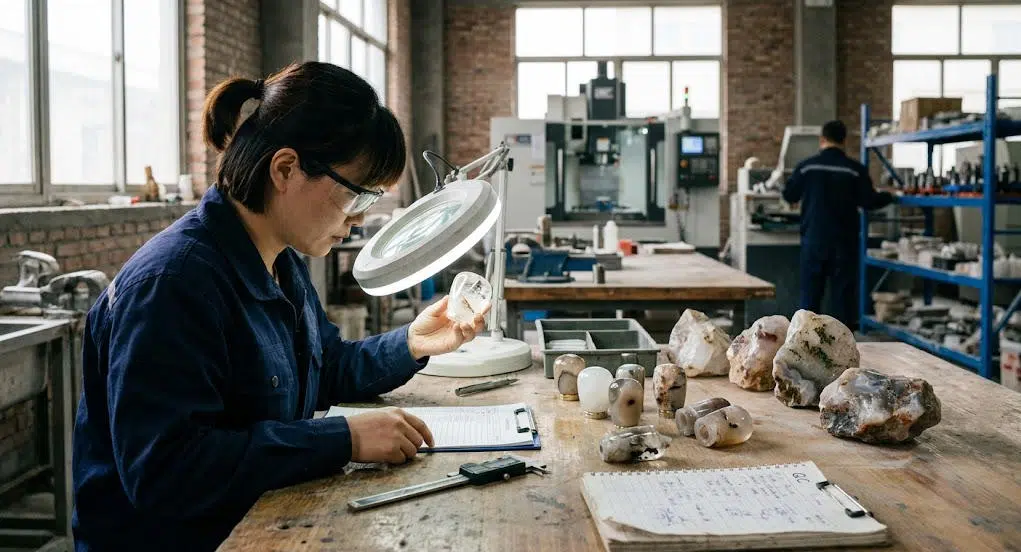
If you’ve priced out a perfume cap custom order in natural crystal or stone next to a resin quote, the gap on the invoice probably surprised you. That gap is not a story someone made up to justify a higher number. It comes from a simple fact: quartz, agate, and jade score around 7 on the Mohs hardness scale, the same reference system used by the Gemological Institute of America, while resin has no comparable hardness rating at all because it is engineered, not mined. Hard does not mean easy to shape, and it does not mean free of internal flaws.
What you’re really paying for in a perfume cap custom quote is the labor of managing a material nature never designed for repeatable output. That’s the real economics behind a perfume cap custom program, and it starts with the rock itself, not the invoice. This breakdown comes from inside a Stone Elf production floor — a working natural perfume cap factory view of the numbers, not a sales pitch.
Table of Contents
The Core Reason Behind Every Perfume Cap Custom Quote: Yield, Not Markup

Resin behaves the same way every time it enters a mold. Pour it, cool it, eject it, and part 1 looks like part 10,000. A perfume cap custom order in resin is, in essence, a repetition problem: solve it once, then repeat. Natural stone refuses that logic. Every rough piece carries its own internal history — a hairline fracture from tectonic pressure, a cluster of trapped minerals, a zone of uneven density — and none of it shows up until the material is already being cut.
This is why yield, not the price of raw material, drives most of the cost difference you see on a crystal perfume cap wholesale quote. A cutting error, a drilling crack, a chipped edge during CNC shaping, or a hidden inclusion that surfaces only after final polishing can each turn a finished-looking piece into scrap. You are not just paying for the caps that ship. You are paying for the caps that didn’t survive the process, because a stone perfume lid manufacturer has to build that loss into every quoted unit. That distinction matters most when you’re comparing two perfume cap custom quotes that look similar on paper but rest on very different risk assumptions underneath.
Where Natural Stone Actually Breaks During Machining
The center bore is usually where things go wrong first. That interior channel has to align precisely with the bottle neck, the spray pump, the plastic liner, and sometimes a metal collar or magnet housing — so it can’t be an afterthought carved loosely into the middle of a pretty exterior shape. When a design calls for thin cap walls, a deep bore, a wide bore diameter, and tight clearance between the inner and outer wall simultaneously, the risk of a crack at drilling stacks fast. Ask yourself: would you accept a 20% failure rate on a batch of 5,000 units if nobody told you it was coming? A transparent stone perfume lid manufacturer like Stone Elf tells you that risk exists before the tooling ever starts, not after the invoice for reworked parts lands on your desk. A perfume cap custom brief with a deep, wide center bore and thin surrounding walls is exactly the spec that turns a routine batch into a high-risk one.
What Yield Risk Means for Your Perfume Cap Custom Landed Cost
This means you can plan your budget around a real number instead of a surprise one. When a factory quotes a perfume cap custom project honestly, the price already folds in scrap cost, rework labor, and material loss — so the number you see upfront is closer to the number you’ll actually pay at delivery, without a change order six weeks in. That’s the opposite of a bait-and-quote model where the first price looks attractive and the real cost shows up after tooling has already started.
Raw Material Variation: Why Crystal Can’t Be Priced Like Resin by Weight

Glass and resin manufacturers can dial in color, transparency, and physical consistency through a controlled formula. You ask for a Pantone reference, and the factory hits it, batch after batch. Natural rough doesn’t work that way, and no amount of polishing changes that reality. Within a single batch of quartz or agate rough, you’ll typically find color banding, cotton-like inclusions, fracture lines, trapped minerals, black spots, and gradients in transparency — sometimes all inside pieces mined from the same pocket.
This is precisely the distinction the International Gem Society and GIA draw when they separate gem clarity into type categories: some species form with very few inclusions, others form with many, and that’s a matter of geology, not sorting effort. A stone perfume lid manufacturer cannot simply buy raw material by the kilogram and expect matching output — rough has to be sorted and graded before a single piece touches a cutting wheel. A-grade transparent material, standard-grade material, and material with visible impurities are three different cost tiers before any labor is applied, and treating them as one line item on a quote would be dishonest. Every perfume cap custom brief really starts with one question: how much of nature’s inconsistency are you willing to accept, and how much are you willing to pay to engineer it out?
Grading Rough Material Before It Enters a Perfume Cap Custom Production Run
The tighter your specification for color, clarity, and texture uniformity, the more rough material has to be screened out before production even begins. A perfume cap custom brief that says “must match exactly” is really asking a factory to reject a large share of otherwise usable stone, and that rejected material still cost money to mine, cut for testing, and evaluate. So what does that mean for you? It means the specification you write directly sets your material cost — tighten uniformity and the price rises with it, loosen it and the price comes down, often significantly.
What GIA and IGS Clarity Standards Tell You About Natural Stone
Clarity grading exists in the gem trade precisely because natural material varies piece to piece, and professional graders needed a shared vocabulary for describing that variation rather than pretending it doesn’t exist. The same logic applies to a crystal perfume cap wholesale order: when a brand accepts natural variation as part of the material’s identity rather than a defect to eliminate, sourcing gets faster and pricing drops, because far less rough has to be discarded to hit the spec. You get to choose where on that spectrum your project sits, and that choice — more than almost anything else — determines your final unit price. A perfume cap custom order built around Natural Variation, rather than forced uniformity, is often the single biggest lever you have over price.
From Rough Cut to Finished Polish: The Perfume Cap Custom Machining Process
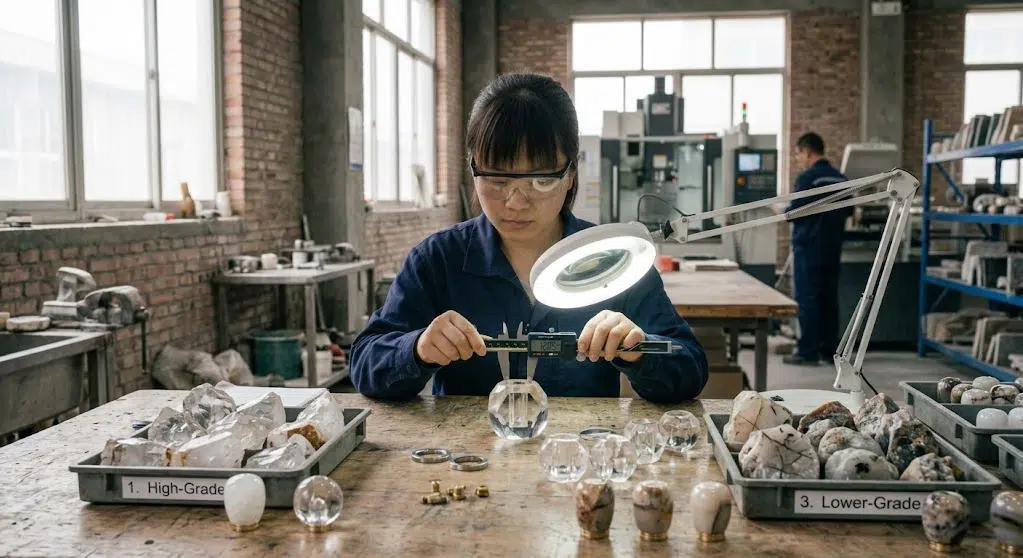
Resin becomes a cap the moment it leaves an injection mold — one step, repeated thousands of times. Stone never gets that shortcut. A perfume cap custom piece in crystal or agate moves through cutting, rough grinding, shaping, CNC machining, drilling, fine grinding, polishing, cleaning, and inspection, roughly nine distinct stages before it’s ready to leave the workshop. Skip a stage or rush one, and the defect doesn’t stay hidden — it shows up two stages later as a crack you can’t repair. This is the sequence a natural perfume cap factory like Stone Elf walks every perfume cap custom order through before it ever reaches your inspection report.
None of this is about making a pretty exterior shape. The part of a perfume cap custom design that actually determines cost and risk is almost always invisible from the outside: the internal cavity. That cavity has to seat correctly against the bottle neck, hold a spray mechanism, wrap around a plastic liner, and in some designs, accommodate a metal sleeve or a magnet. Every one of those interfaces has its own tolerance, and stone doesn’t flex to meet you halfway the way a soft polymer gasket might. So the cavity isn’t a hole ground into a nice-looking rock — it’s a precision-fit component that happens to be made of rock. That single detail is what separates a perfume cap custom order that fits your bottle line the first time from one that comes back for rework.
Nine Steps Between a Block of Stone and a Finished Cap
Cutting separates usable material from rough. Grinding removes bulk and establishes the rough outer form. Shaping brings the piece close to final geometry, and CNC machining takes over from there for anything requiring tight tolerances — flat faces, symmetrical curves, or repeatable angles across a production run. Drilling opens the center bore, arguably the single highest-risk operation in the entire sequence, because the tool is removing material from the middle of a piece that has already survived seven earlier stages without a crack. Fine grinding and polishing bring the surface to its final finish, and a cleaning pass removes residue before final inspection catches anything the earlier stages missed.
This means your lead time on a perfume cap custom order isn’t arbitrary — it’s the sum of nine sequential checkpoints, each one capable of stopping a piece from moving forward. A resin supplier can quote you a delivery date almost entirely based on mold availability and machine hours. A stone perfume lid manufacturer has to build in time for a percentage of pieces to fail partway through and need to be replaced from a fresh blank, which is exactly why realistic lead times for natural material run longer than they do for resin, and why a factory that promises resin-speed turnaround on a perfume cap custom order in stone is quietly setting you up for a missed date.
Matching the Center Cavity to Your Bottle Hardware
Hardness and toughness are not the same property, and this distinction matters more during drilling than at almost any other stage. As the International Gem Society notes, a material can resist scratching while still being brittle enough to shatter or split under concentrated impact — quartz is a clear example, hard enough to resist surface wear yet prone to splitting cleanly along internal planes of weakness when a drill bit hits the wrong spot. That’s precisely why a deep, wide-diameter bore drilled into a thin-walled cap is treated as a flagged specification rather than a routine one. You can reduce that risk at the design stage simply by asking your supplier to review bore depth and wall thickness together, before tooling starts rather than after the first cracked batch comes back from CNC. Building that review into the front end of a perfume cap custom brief costs you nothing and can save an entire production run.
Design Freedom: Why Complex Perfume Cap Custom Shapes Cost More in Stone
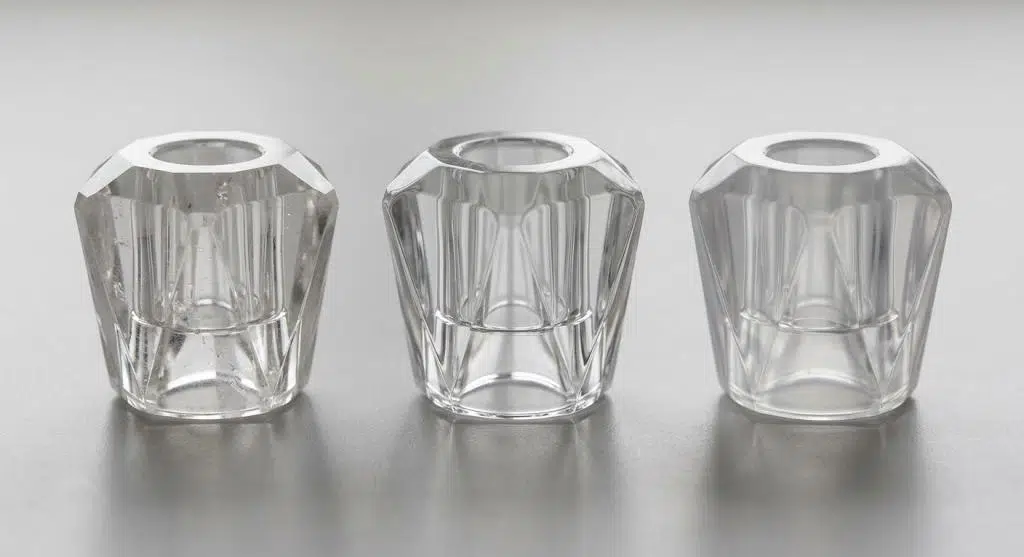
A resin mold can produce a rounded edge, a recessed groove, a snap-fit clip, and an internal support rib in a single shot, because the material flows into every corner of the cavity before it sets. Natural stone can’t flow anywhere. Every one of those same features has to be removed from solid material, one pass at a time, which means design complexity in stone doesn’t add cost the way it does in resin — it multiplies it, because each additional feature is a separate machining operation with its own chance of failure. This is the part of a perfume cap custom brief that a factory like Stone Elf reads first, before ever discussing price.
Faceted crystal caps make this especially visible. Every additional facet face means another positioning setup, another clamping sequence, and another CNC pass, and each of those steps carries its own small probability of a chip or a misalignment. A cap with six facets isn’t twice the work of a cap with three — it’s closer to three or four times the work, once you account for the repositioning and inspection between each cut. So what does that mean for your design brief? It means the fastest way to control your perfume cap custom budget isn’t necessarily to simplify the whole cap — it’s to identify which two or three features are actually load-bearing for your brand identity, and treat everything else as negotiable.
What Happens When You Add a Facet
Deep grooves, very thin wall sections, compound curves, off-center cavities, and multi-level internal chambers all behave the same way under machining: they raise both processing time and failure probability simultaneously, and the two rise together rather than trading off against each other. A crystal perfume cap wholesale buyer who wants a faceted, deep-cavity, thin-wall design in one single specification is effectively asking for the three hardest variables in stone machining at once. This means you’ll get a more honest quote, and a more realistic delivery date, if your stone perfume lid manufacturer flags which specific feature is driving the price before tooling starts — not a vague “complex design surcharge” buried in a lump-sum number you can’t take apart.
The Cost Formula Behind Every Perfume Cap Custom Quote
Once you line up all seven factors above, the pricing logic stops looking arbitrary. A perfume cap custom quote in natural stone is really adding together raw material plus grading loss, cutting and CNC labor, drilling risk, polishing, yield loss, four-layer QC, packaging, and a reasonable margin — not one dramatic markup, but eight ordinary line items that each run a little higher than their resin equivalent. A resin quote, by comparison, is mostly resin material, mold amortization, molding labor, basic QC, packaging, and margin — five items, most of them highly predictable.
Neither structure is wrong. They’re just built for different materials, and now you know which levers in a perfume cap custom brief actually move your price: uniformity requirements, bore geometry, facet count, and order volume. Pull any one of those levers and the number changes in a way you can predict before you ever request a formal quote.
About Stone Elf: 12 Years Behind the Machines, Not the Sales Desk
Stone Elf has spent more than twelve years as a source-factory for crystal and jade perfume caps — designing, cutting, drilling, and finishing at the same site, rather than trading finished parts made somewhere else. That vertical setup is what lets a natural perfume cap factory like this one give you yield numbers, lead times, and QC data based on its own production floor instead of a supplier three steps removed from the CNC machines.
If you’re evaluating a crystal perfume cap wholesale partner or comparing quotes from more than one stone perfume lid manufacturer, the questions in this article are the ones worth asking directly: what’s your yield rate on bores this deep, how many QC layers run on 100% of units, and where does my order size sit on the resin-versus-stone cost curve? A factory that can answer all three without hesitation is one that’s priced your perfume cap custom project honestly from the start.
Frequently Asked Questions
1. Is a crystal perfume cap always more expensive than resin?
Not always. At low volumes — roughly a thousand units or fewer — a perfume cap custom order in stone can land close to a resin price once you factor in resin’s mold amortization. The gap widens mainly at high volume, which is where most crystal perfume cap wholesale buyers start comparing resin seriously for the first time.
2. How can I lower the cost of a stone perfume cap custom order?
Accept natural variation instead of demanding uniform color and clarity, simplify bore geometry where your bottle hardware allows it, and limit facet count to features that genuinely carry your brand identity. Each of those choices reduces grading loss or machining risk directly.
3. What MOQ makes natural stone cost-competitive with resin?
There’s no fixed number — it depends on your specific design complexity and your resin mold cost — but ask any natural perfume cap factory you’re evaluating to show you the crossover point in writing rather than accepting a general claim.
4. Does Stone Elf take on smaller perfume cap custom orders, not just large-volume production?
Yes. Because tooling dependency is low for stone, smaller and sample-stage orders are practical without the mold-amortization penalty resin production carries at low volume.