
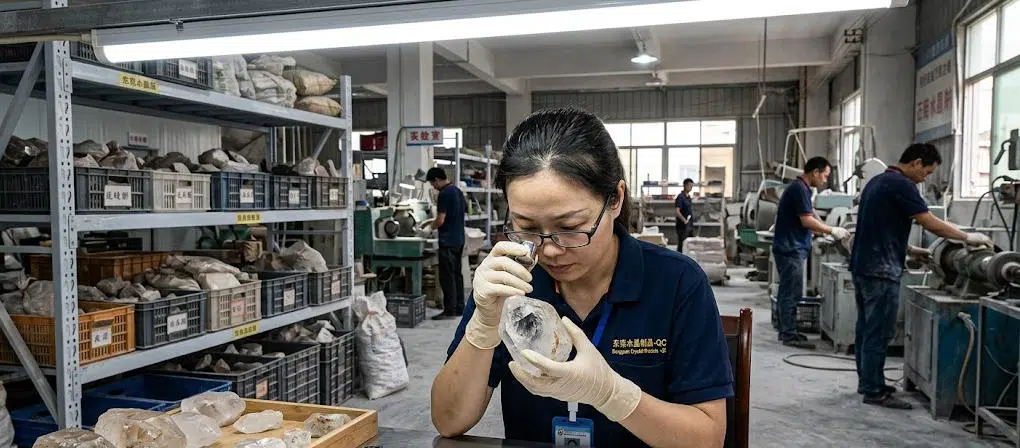
A crystal perfume cap manufacturer starts every order with a loupe, not a polishing wheel. Quartz-family material — the base of most natural crystal caps — sits at 7 on the Mohs hardness scale, the same durability class gemologists at GIA use to separate stones that tolerate daily handling from stones that need extra care. That single hardness number tells you how fast the material can be cut. It says nothing about whether the rough block you are paying for is even usable, and that gap is exactly where most wholesale orders go wrong.
You are not buying a decorative object when you place an order for natural crystal or stone perfume caps. You are buying a manufacturing outcome — a yield rate, a tolerance range, a finish that repeats from the first unit to the ten-thousandth. That outcome is set long before polishing starts, at the moment the raw stone is graded, cut, and assigned to a production line. The sections below walk through what actually controls that outcome, starting with the part that decides whether your order ships on time at all.
What a Crystal Perfume Cap Manufacturer Checks Before the First Cut

Rough crystal and rough stone rarely leave the ground defect-free. Large, clean blocks are the exception, not the rule, and every crystal cap manufacturer has to work around that reality rather than pretend it doesn’t exist. The screening that happens before cutting is where your final yield rate is actually decided, not on the polishing bench where most buyers assume the real work happens.
Why Rough Stone Completeness Decides Your Yield
Internal cracks, healing fractures, mineral inclusions, fluid pockets, layered banding, and growth lines are common in natural rough, and each one behaves differently once a cutting wheel or drill bit gets near it. A surface-level jewelry stone can tolerate a small inclusion because it only affects appearance. A perfume cap cannot, because it goes through cutting, CNC shaping, center-drilling, and metal-insert assembly — four separate stages where a hidden flaw can turn into a finished-goods rejection. Independent gemological labs such as SSEF document internal fractures and fluid inclusions under magnification for exactly this reason: what looks fine to the eye often is not fine at all once the material is put under mechanical stress. This means the batch that photographs well is not automatically the batch that survives production — and a stone cap manufacturer that skips this screening step is passing that risk directly to you.
The Center-Drilling Risk a Crystal Perfume Cap Manufacturer Plans For
Center-drilling is generally the highest-risk operation in the entire process. If a hidden crack sits anywhere near the drill path, the bit can trigger a chip or a full split that never shows up until the metal core is pressed in, or worse, until the finished cap is already in transit to your warehouse. Have you ever received a batch that looked flawless in photos but failed the moment an insert was seated? That is almost always a hairline fracture no camera could catch at normal resolution. A stone cap manufacturer that pre-screens rough material under magnification before committing it to drilling catches this at the workshop stage, where a rejected block costs a few dollars of raw material. This means your rejection rate gets resolved before shipping, not three weeks later when a customs invoice has already been paid.
Placing a crystal lid wholesale order without a pre-drilling inspection step is, in practical terms, an order placed against an unknown internal defect rate. That risk does not disappear when the container clears customs — it simply transfers from the workshop floor to your warehouse, where it is far more expensive to discover. A written inspection record, even a simple one showing what percentage of a batch was rejected before cutting and why, gives you something concrete to compare across suppliers instead of relying on how a sample box happens to look.
Structural Strength: Why Hardness Alone Won’t Protect Your Order

Hardness gets most of the attention in gemstone marketing, but it only answers one question: how well does the surface resist scratching. It says nothing about whether the cap will survive being twisted, dropped, or pulled off a bottle neck repeatedly over months of retail handling. That distinction matters more to a functional component than it does to a piece of jewelry that mostly sits still in a display case.
Toughness vs. Brittleness in Daily Use
Gemologists at GIA break gemstone durability into three separate properties — hardness, toughness, and stability — and note explicitly that a stone can rank high on one axis while performing poorly on another. A material can be hard enough to resist scratches and still be brittle enough to crack from a single sharp knock, because toughness measures resistance to breaking, not resistance to scratching. This means two crystals with identical Mohs ratings can behave in completely different ways once they are mounted, twisted, and handled thousands of times at retail counters and in customers’ bathrooms.
A crystal cap manufacturer working from graded rough typically records toughness separately from hardness on internal batch sheets, precisely because the two properties diverge often enough to matter. A stone that scratches poorly under a fingernail test can still shatter cleanly along an internal plane the moment it takes a sideways knock during shipping. Why does this distinction get skipped so often in supplier conversations? Mostly because hardness is easy to quote as a single number, while toughness only shows up in how a batch actually performs after weeks of handling — which is harder to summarize on a spec sheet, though no less important to your return rate.
What a Crystal Perfume Cap Manufacturer Looks for in Grain Direction
Some crystal varieties carry visible internal grain lines, and a stone under impact tends to split along that grain rather than in a random direction. A crystal cap manufacturer that ignores grain orientation during cutting is essentially betting that the finished cap will never take a hard knock during shipping, retail handling, or daily use — a bet that fails often enough to matter at scale. Planning the cut around grain direction, instead of cutting for maximum size first, typically trades a small amount of material yield for a large drop in field failures. This means your return rate and your customer complaints about “the cap just split” both trace back to a decision made at the cutting stage, long before the product ever reached a shelf.
A stone cap manufacturer that documents grain orientation alongside grade level gives you a second layer of quality data beyond the standard A/B/C classification, and that second layer is usually what separates a supplier relationship that survives a large order from one that does not.
The Real Cost Behind Every Crystal Perfume Cap Manufacturer’s Quote

Raw material price is the number every buyer sees first, and it is also the number that tells you the least about your actual landed cost. Two quotes with the same per-kilogram rough price can produce very different per-unit costs once yield, rework, and rejection rates enter the picture.
Why Cheaper Rough Material Often Costs You More
Lower-grade rough usually comes with a lower purchase price and a higher hidden cost: more processing loss, a higher scrap rate, more units sent back for rework, and more hours spent on quality inspection to catch problems before they reach you. Does a 20% discount on raw material actually save you money once rework and delayed shipments enter the equation? In most crystal lid wholesale transactions, it does not, because the labor and time lost to reprocessing a flawed batch usually costs more than the material saved. A stone perfume lid wholesale buyer comparing two quotes purely on price per kilogram is comparing the wrong number. Quality-control hours are the least visible line item in this comparison, and often the most telling one: a batch that requires double or triple the normal inspection time to sort acceptable pieces from defective ones is quietly adding labor cost to every unit that does pass, whether or not that cost ever appears on the invoice you receive.
How Yield Rate Changes Your Per-Unit Price
Consider two batches of the same rough material by weight. One yields roughly 45 usable caps per kilogram after cutting and rejection; the other, screened and graded before cutting, yields closer to 65. That difference alone moves the effective per-unit material cost by close to a third, before labor, tooling wear, or quality-control hours are even counted. This means the higher-priced quote from a crystal perfume cap manufacturer with a documented grading process can land cheaper per finished unit than the lower-priced quote from a supplier that cuts first and sorts later. For a recurring crystal lid wholesale order, that yield difference compounds every reorder cycle, since a stable yield rate is also what lets a factory hold a price steady instead of re-quoting upward after the first problem batch. A stone perfume lid wholesale contract negotiated purely on unit price, without any yield or rejection-rate benchmark attached, tends to leave the buyer with no real recourse when a batch underperforms — there is nothing in writing to point back to. Building a yield expectation into the purchase agreement itself, even a simple minimum percentage, turns an informal understanding into something you can actually enforce.
Grading Systems Behind Stable Stone Perfume Lid Wholesale Orders

Natural material varies from batch to batch even within the same stone name, and that variation is the single biggest obstacle to running a repeat wholesale order without surprises. A grading system is what turns unpredictable rough stone into something you can actually plan a production schedule around.
A, B, and C Grade Criteria, Explained Plainly
Grade A material typically shows high transparency, minimal cracking, and even coloring, and it is generally reserved for higher-end product lines where visual consistency matters most. Grade B carries minor surface or internal imperfections that are acceptable for standard product lines but would stand out on a flagship item. Grade C shows defects serious enough to disqualify it from cap production altogether, regardless of price. A stone perfume lid wholesale order built entirely from ungraded, mixed material is effectively a random sample of all three grades, which is exactly why batch-to-batch inconsistency shows up so often in unscreened supply chains. A repeat crystal lid wholesale buyer benefits most from grading, since the whole point of a repeat order is that unit five thousand should look like unit one, not like a different product wearing the same SKU number.
Questions to Ask Any Crystal Perfume Cap Manufacturer About Batch Consistency
Before confirming a wholesale order, it is worth asking a crystal cap manufacturer for the grade allocation percentage within the batch, the sampling rate used during quality control, and whether rejection criteria are documented in writing rather than left to an inspector’s judgment on the day. It also helps to request close-up photos taken under magnification rather than standard product shots, since surface photography rarely reveals internal cracking. This means you get a way to compare suppliers on process, not just on price — and a supplier who cannot answer these questions in specific terms is telling you something important about how the batch was actually sorted. A stone perfume lid wholesale relationship that starts with these questions on the table tends to need far fewer difficult conversations six months in, once volume has scaled past a first sample order. Why does this matter more for stone than for glass or metal caps? Because a glass supplier can promise identical units indefinitely — the raw material itself has no variation to manage. A natural-stone supplier is managing variation by design, and grading is the tool that keeps that variation inside boundaries you actually agreed to, rather than boundaries set unilaterally by whatever rough happened to arrive at the workshop that month.
Hardness Data a Crystal Perfume Cap Manufacturer Works Around Every Day

Hardness numbers translate almost directly into cutting time, tool wear, and finishing cost, which is why they sit at the center of any production planning conversation, even though hardness alone does not determine durability.
Quartz, Amethyst, and Agate Compared
According to the Mohs hardness ordering maintained by the International Gem Society, clear quartz and amethyst both sit at roughly 7 on the scale, which means slower cutting speeds and longer polishing cycles, but also better resistance to everyday wear once the cap is finished. Amethyst carries the added complication of being more prone to internal fracturing than clear quartz, so grading has to account for both hardness and crack density at the same time. Agate typically falls between 6.5 and 7, with a denser, more layered internal structure that tends to hold up well through precision machining. This means the “hardest” material is not automatically the easiest or cheapest to work with — hardness and workability often pull in opposite directions. Jade-family stone, which some product lines specify by name rather than by hardness rating, generally requires more experienced tooling operators than quartz-family material does, since its fibrous internal structure behaves differently under a cutting wheel than a single-crystal stone. A crystal lid wholesale order that mixes quartz-family and jade-family caps in the same production run should expect two different cutting timelines, not one shared schedule.
Why Soft Stones Need a Different Production Line
Materials like calcite and fluorite carry attractive coloring but sit well below quartz on the hardness scale, and some are also more brittle, which raises the odds of chipping during cutting even at low pressure. Running these materials through the same tooling and speed settings used for quartz-family stone typically produces a noticeably higher scrap rate. A crystal cap manufacturer that maintains separate processing parameters for softer material — slower feed rates, lighter clamping pressure, different polishing compounds — trades some throughput speed for a lower rejection rate. This means a request for a softer, more colorful stone should come with a conversation about realistic lead times, not just a price quote. A stone cap manufacturer that quotes the same turnaround for calcite and quartz is either underestimating the scrap rate on the softer material or planning to absorb it quietly — neither outcome tends to work out well for a buyer once volume increases.
Optical Clarity: Why a Crystal Perfume Cap Manufacturer Chases Light, Not Just Shine
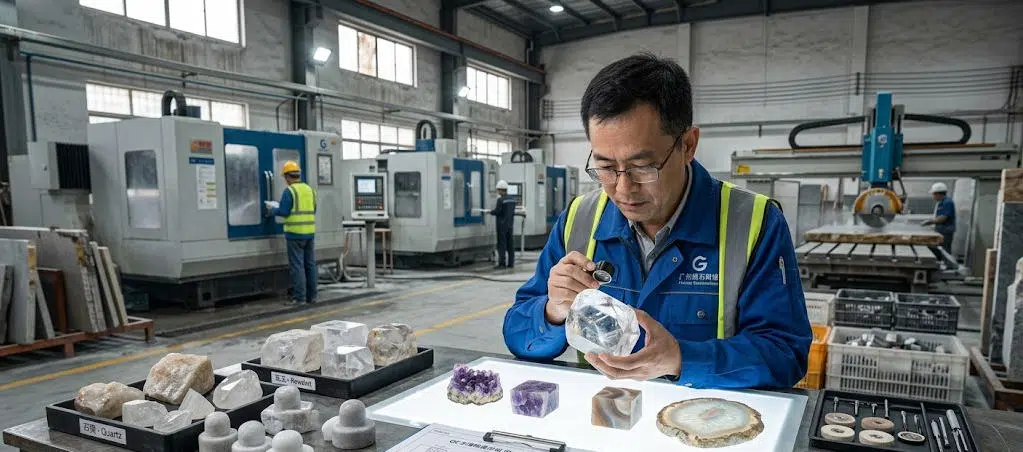
Clarity is where a natural crystal cap earns the visual comparison to fine jewelry rather than to costume packaging, and it is often the single biggest factor separating a flagship SKU from a standard one.
How Light Refraction Adds Shelf Value
Material with strong light transmission, a clean internal structure, and even coloring produces visible depth and refraction once it is cut and polished — the same optical qualities that give faceted jewelry its sense of dimension. That visual effect is difficult to fake with glass or resin, which is precisely why brands pay noticeably more for it in the first place. This means a genuinely transparent, inclusion-free crystal cap can justify a retail price point that a cloudier substitute simply cannot support, independent of packaging or branding around it. A crystal lid wholesale buyer targeting a flagship fragrance line typically specifies clarity grade explicitly in the purchase order for this reason, rather than leaving it to a general product description, since “clear” and “grade A clear” can mean very different things once a batch actually ships.
When Cloudy or Pearlescent Stone Still Performs
Not every natural stone needs to be optically clear to earn its place on a shelf. Materials with a milky or pearlescent finish carry a different kind of visual interest, and they can still read as elevated packaging when the cutting emphasizes form, the surface polish is even, and the piece is paired with a contrasting metal collar or base. Does every cap need to be museum-clear to look expensive? Not when the design leans on silhouette and material pairing instead of transparency alone. A stone cap manufacturer working with lower-clarity material typically shifts the design strategy toward shape and contrast rather than trying to force clarity that the raw stone does not naturally have. This is often the right call for a stone perfume lid wholesale line positioned below a brand’s flagship SKU, where the cost savings from lower-clarity material can be reinvested into a distinctive silhouette instead of chased into a transparency the raw stone was never going to deliver. Surface finish plays into this decision as well: a matte or satin polish tends to flatter opaque and pearlescent material, while a high-gloss polish is where transparent crystal shows its refraction to best effect, so the finishing step should match the clarity grade of the stone rather than defaulting to one polish style across an entire product range.
How a Crystal Perfume Cap Manufacturer Adjusts Strategy for Each Batch

No two batches of natural rough behave identically, which means a fixed, one-size-fits-all production process is one of the more common causes of inconsistent quality in this category.
Slow-Drilling Protocols for High-Clarity Crystal
High-clarity crystal generally calls for slower drilling speeds, multi-stage passes instead of a single continuous cut, and careful attention to heat buildup, since sudden temperature changes can trigger internal fracturing in material that looked perfectly clean beforehand. Cutting position also matters: starting from the area with the fewest visible inclusions, rather than the geometric center of the rough block, tends to preserve more usable, defect-free material per stone. This means a slower production pace on high-clarity material is not a delay — it is the mechanism that keeps your defect rate low enough to justify the higher price point in the first place. A crystal cap manufacturer running multi-stage drilling on high-clarity rough typically cuts drill speed by roughly a third compared to standard-grade material, trading throughput for a measurably lower fracture rate at the drill hole — the single point of failure most warranty claims trace back to.
Designing Around Natural Inclusions Instead of Fighting Them
Material with visible inclusions or banding calls for a different approach entirely: planning the cutting direction around the natural texture instead of against it, and treating the inclusion as a design feature rather than a flaw to disguise. A stone cap manufacturer that plans cuts this way generally gets more usable material out of an imperfect block than one that tries to cut around every flaw as if it were working with flawless rough. This means a batch with visible natural character does not have to be downgraded to a lower price tier — it can be repositioned as a distinct visual line, provided the imperfections are structural non-issues rather than crack risks. The two strategies above are not interchangeable, and applying the wrong one to a given batch wastes material either way: running high-inclusion rough through a high-clarity protocol burns processing time on stone that was never going to reach flagship transparency, while running clean rough through a fast, inclusion-tolerant protocol throws away clarity you already paid for. Matching the strategy to the batch, rather than applying one default process to everything that comes off the same truck, is where a documented grading step earns its cost back.
Compliance and Disclosure: What “Natural” Should Mean on Your Product Page

Getting the material right on the workshop floor solves only half the problem. The other half is making sure your product descriptions match what regulators and customers actually expect when they see the word “natural” attached to a gemstone component.
Regulatory and Labeling Expectations for Natural Gemstone Components
In the United States, the FTC Jewelry Guides, codified at 16 CFR Part 23, treat it as a deceptive practice to fail to disclose a gemstone treatment if that treatment is not permanent, requires special handling, or materially affects value. These rules apply across the supply chain — to manufacturers and suppliers, not only to the retailer facing the end consumer — which means the disclosure obligation does not stop at your factory gate just because you are selling components rather than finished jewelry. A stone perfume lid wholesale buyer reselling into a market with similar disclosure expectations inherits this responsibility the moment the product ships, whether or not that expectation was written into the purchase order. In practice, meeting that standard is fairly mechanical: confirm in writing whether any dyeing, heat treatment, or stabilization was applied to the material, keep that documentation on file, and make sure the same information appears somewhere a buyer can actually find it before checkout rather than only in a private response to a support ticket.
Setting Buyer Expectations Before the Container Ships
Natural variation is not the same thing as a defect, and mixing the two up on a product page creates real risk. Color shifts, visible internal texture, and minor natural inclusions are expected characteristics of genuine crystal and stone, not flaws — but that distinction only protects you if it is stated clearly before a customer opens the box, not explained afterward as a customer-service response to a complaint. This means your product descriptions and your supplier’s documented QC criteria need to agree with each other before the first container leaves port. A mismatch between what a crystal cap manufacturer ships and what your listing promises is where most disclosure disputes actually start, and it is almost always preventable with a short paragraph of plain-language variation disclosure on the product page itself. Isn’t it easier to write that paragraph once, before launch, than to answer the same complaint over and over across a hundred separate customer messages? Most manufacturers who have handled a return spike over disclosure would agree it is.
Summary: The Eight Factors Every Crystal Perfume Cap Manufacturer Tracks
The table below condenses the factors covered above into the shorthand a production team actually works from day to day.
| Material Factor | Effect on Manufacturing |
|---|---|
| Crack density | Sets the achievable yield rate and drilling safety margin |
| Transparency | Drives perceived value and visual comparison to fine jewelry |
| Inclusion level | Determines appearance consistency across a batch |
| Hardness | Sets cutting speed, tool wear, and finishing cost |
| Toughness | Determines shipping and in-use failure risk |
| Color stability | Controls how closely a repeat order matches the last one |
| Rough block size | Limits which cap dimensions are even possible |
| Internal structure | Predicts drilling risk before the bit ever touches the stone |
None of these factors work in isolation, and none of them can be reduced to a single “clearer equals more expensive” rule. A rough stone’s value to a crystal perfume cap manufacturer is really a composite score across transparency, structural stability, machinability, and how consistently that same score repeats across an entire production run.
About Stone Elf: A Crystal Perfume Cap Manufacturer Working From the Source
Stone Elf has spent more than twelve years processing, designing, manufacturing, and selling natural crystal and jade perfume caps directly from the raw material stage, without intermediaries between the rough stone and the finished component. That source-level position is what makes grading, batch documentation, and processing-strategy decisions possible in the first place — you cannot control what you do not process yourself. The goal across that time has stayed the same: balance production efficiency with material quality, rather than treating the two as a trade-off you are forced to accept.
Getting Your Next Batch Right
If your current supplier cannot answer specific questions about grade allocation, rejection criteria, or batch-to-batch color consistency, that gap tends to show up eventually as a shipping delay or a return you did not budget for. A conversation about your material specification, your target grade mix, and your expected order volume is usually enough to tell you, before any money changes hands, whether a crystal lid wholesale or stone cap manufacturer partnership will actually hold up at scale.