

If you buy from a crystal lid manufacturer and expect every cap to arrive with zero internal marks, you’re setting yourself up for a disappointing inspection report. Natural quartz forms under pressure and heat over geological time, and it tests at 7 on the 10-point Mohs hardness scale — hard enough to resist everyday scratching, but not immune to the mineral pockets, hairline cracks, and cloudy zones that form while the crystal is still growing underground. A factory that promises “no inclusions, guaranteed” is either quoting synthetic material at natural-crystal prices or hasn’t cut enough stone to know better. What you actually need from a crystal cap manufacturer is a system — raw material grading, cut orientation, and drilling discipline that keeps crystal cap materials risks inside a predictable range instead of pretending they don’t exist. That’s the process this article walks through, the way it actually runs on a production floor, not the way it reads on a sales page.
Why a Crystal Lid Manufacturer Doesn’t Chase “Zero Inclusions”
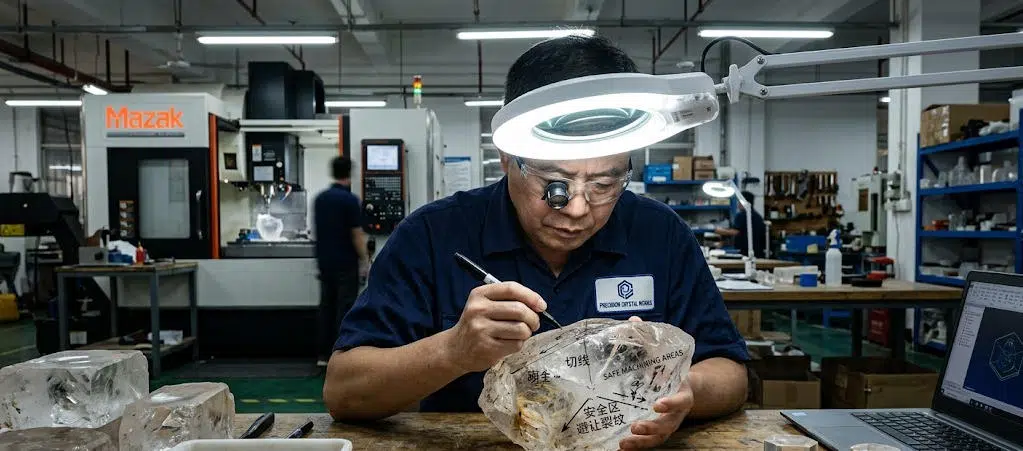
Ask any lab that grades gem-quality material and you’ll get the same answer: natural crystal without a single internal feature barely exists outside a jewelry display case. GIA classifies colored stones and quartz varieties into distinct clarity types precisely because inclusion-free material is the exception, not the baseline — their research on how inclusions form and what they reveal about a stone’s growth history is worth a read if you’re sourcing crystal components for the first time. That’s a useful reference point, because it tells you the honest range of what “natural” looks like before a piece ever reaches a polishing wheel. A crystal lid manufacturer that skips this reality and promises flawless material every single time is either not being straight with you about what actually gets rejected during selection, or working with something other than genuine crystal.
What Counts as an Inclusion in Natural Quartz
Inside a block of rough quartz you’ll typically find some mix of trapped mineral crystals, gas or liquid pockets, hairline fractures, iron-oxide staining, and cloudy “milk” zones where growth conditions shifted mid-formation. None of these are manufacturing defects. They’re geological history, and they were there long before the stone reached a cutting table. This means that when you’re comparing quotes from different suppliers, the honest question isn’t “does this stone have inclusions” — it’s “where do they sit, and do they fall inside a load-bearing zone like a drill hole.” A stone with a small cloud pocket tucked into a hidden base has a completely different risk profile than one with a hairline crack running straight through the center bore, even if both technically “have an inclusion.”
The Question That Actually Matters on the Factory Floor
Here’s what actually changes the outcome for your order: whether the factory treats inclusion management as a fixed checkbox on an inspection sheet, or as a fresh decision made for every single block of rough material. A crystal cap manufacturer working the second way examines each stone under strong light, marks out the danger zones, and only then decides how to cut it. Skip that step, and you’re gambling that this particular block happens to be clean exactly where you need it to be — which is a bad bet on a natural material. So what does that mean for you as a buyer? It means your reject rate, your unit cost, and your lead time are effectively set at the selection table, weeks before a single machine touches the stone.
How a Crystal Lid Manufacturer Grades Rough Stone Before Cutting Starts

Before a single wheel touches the stone, a crystal lid manufacturer runs the rough block through a grading pass, and this step decides more about your final unit price than anything that happens afterward. Rough material gets screened under high-intensity light so the technician can see straight through it, rotated by hand to check the internal structure from every angle, then washed to reveal true color once surface dust is gone. Crack direction gets mapped at this stage too, because a crack running parallel to the intended bore is a very different problem than one running straight across it. Skip this pass or rush it, and the risk simply moves downstream to drilling and CNC work — where a mistake costs far more than a piece of rough stone ever did.
Visual Screening Under Strong Light
The technician is checking for a specific, short list of warning signs: dark mineral points, brownish-yellow iron staining, broad cloudy zones, internal fracture lines, gas-bubble pockets, and growth banding that could telegraph through a polished surface later. Each of these behaves differently once the stone is machined. Black mineral inclusions mostly hurt appearance — they cut transparency and read as a flaw on a display-facing cap. Iron oxide shows up as yellow or brown spotting a customer will notice on the shelf, which is a cosmetic problem more than a structural one. Internal cracks matter the most, because they’re exactly what tends to open up the moment a drill bit or CNC tool applies pressure nearby. This means the grading pass isn’t really about beauty first — it’s a map of where the stone can safely be stressed later, and where it can’t.
Three Grades, Three Jobs a Crystal Lid Manufacturer Assigns Them To
Not every block of natural quartz gets treated the same way once it clears screening. Mature factories typically sort rough material into three working grades, each matched to a different product use rather than a single pass/fail line.
| Grade | Typical Use | Defining Trait |
|---|---|---|
| A — clear stock | Full-transparency lids, showcase designs | Minimal inclusions, high light transmission, few cracks |
| B — decorative stock | Larger semi-transparent lids, texture-forward designs | Light inclusions kept intentionally, natural character preserved |
| C — structural stock | Small components, bases, hidden sections | More inclusions present, mechanical strength still sufficient |
A crystal perfume lid wholesale order built entirely on Grade A stock will cost more per unit than one that blends grades intelligently across visible and hidden parts, and neither approach is automatically “better.” What matters is whether the grade matches the part. Put Grade C material into a fully transparent display cap and the inclusions will show through. Put Grade A material into a hidden base component and you’ve paid a clarity premium nobody will ever see. So what does this mean for your sourcing decision? Ask your supplier which grade goes into which part of your design, not just what grade the overall order is quoted at — that single question tells you more about crystal cap materials risks in your order than a certificate ever will.
Orienting the Cut to Route Around Hidden Cracks

Natural stone’s biggest advantage is also its biggest complication: no two blocks share the exact same internal map. A crystal lid manufacturer that treats every block the same way — mark the outer shape, cut, done — is skipping the one step that actually prevents breakage. What separates a controlled process from a lucky one is stone orientation: deciding, before any blade moves, exactly where the cap body, the drill point, and the CNC pass will land relative to the cracks already sitting inside that particular piece.
Stone Orientation Happens Before Any Blade Touches the Block
Orientation starts the same way grading does — under a strong light source, with defect zones marked directly on the stone’s surface. From there, the layout moves to CAD, where the cap’s main body, the bore location, and the CNC toolpath get positioned against that specific map, not against a generic template. This matters because a crack that sits harmlessly at the edge of one cut orientation can run straight through the center bore in another. You’re not paying for a slower process when a factory does this — you’re paying for the difference between a finished cap and a pile of shards.
One Misjudged Cut Line Splits the Whole Blank
Picture a single crystal block with one internal crack running diagonally through it. Cut it the fast way — full cylinder first, center bore drilled straight down the middle — and that crack sits directly in the stress path of the drill, splitting the piece during the very step meant to finish it. Cut it the deliberate way — rotate the layout ten or fifteen degrees so the same crack lands outside the bore’s stress radius — and the identical block produces a usable cap. Same stone, same crack, two completely different outcomes, and the only variable is whether someone looked before cutting. So what does that mean for your order? It means the gap between a low reject rate and a high one often has nothing to do with the raw material grade you paid for, and everything to do with whether the factory bothered to orient the cut.
Drilling: Where a Crystal Lid Manufacturer’s Reject Rate Gets Decided

Of every step in making a crystal perfume cap, drilling is the one that tests a crystal lid manufacturer‘s actual skill level, not just its equipment list. Every cap needs some combination of a center bore, a magnet-mounting hole, a metal connector hole, or space for an internal insert, and every one of those holes concentrates stress in a small area of stone that has already survived millions of years of geological pressure — right up until a drill bit shows up. This is the step where crystal cap materials risks stop being theoretical and start being measured in scrap piles.
Why Uneven Hardness Inside One Stone Creates Micro-Cracks
Quartz sits at roughly 7 to 7.5 on the Mohs hardness scale, a fact well documented in gemological references like the International Gem Society’s hardness guide — but an inclusion sitting inside that same piece of quartz can be noticeably softer or harder than the host material. When a drill bit crosses from one hardness zone into another, the two materials respond to pressure differently, and that mismatch is exactly where a micro-crack starts. Add friction heat from drilling on top of that, and any residual internal stress the stone has held since it formed underground gets a chance to release — sometimes as a clean bore, sometimes as a stone that splits in the operator’s hand. This isn’t a rare edge case for a crystal cap manufacturer working with natural stone daily; it’s the default risk every drilling pass carries, which is exactly why the earlier grading and orientation steps matter so much.
Water-Cooled, Multi-Stage Drilling Cuts the Risk
The countermeasure isn’t exotic, but it is slower — which is exactly why some factories skip it. Water-cooled drilling keeps friction heat from building up in the first place, multi-stage drilling breaks one deep bore into several shallower passes so pressure never spikes in one spot, and reduced feed rates give the stone time to respond instead of being forced through. A mid-process check between stages catches a developing crack before it becomes a finished bore that fails during assembly instead of during production, which is a far more expensive place for it to fail. That’s the tradeoff in plain terms: drilling slower costs a few extra seconds per unit, while drilling fast risks a percentage of your crystal perfume cap wholesale order turning into scrap. Which one shows up on your invoice depends entirely on which shortcut the factory decided not to take.
CNC Machining Around Material That Isn’t Uniform

Metal parts behave predictably under CNC because the material is uniform from edge to edge — set the parameters once, and every unit runs the same way. Natural stone doesn’t offer that convenience, and pretending otherwise is how a crystal lid manufacturer ends up with a batch full of chipped edges and inconsistent surface texture. Hardness, density, and internal structure can all shift within a few millimeters inside the same piece, which means the machine settings that worked perfectly on the last unit might be exactly wrong for this one.
Metal Holds Its Parameters. Natural Stone Doesn’t.
Take a single batch of white quartz caps as an example. Some sections will have stable, predictable hardness all the way through. Other sections will contain mica or other secondary minerals mixed into the structure, and running the same spindle speed, feed rate, and tool pressure across both sections produces very different results — clean edges on the first, chipped edges or surface pitting on the second. A crystal cap manufacturer running a real quality process adjusts speed, feed, and pressure dynamically as the tool moves through different zones of the same stone, rather than locking in one setting and hoping the material cooperates. That adjustment happens by feel and experience as much as by programmed parameters, which is part of why natural-stone machining takes longer to master than metal machining does.
What This Adjustment Actually Protects on Your Order
Picture a large crystal perfume lid wholesale order running through CNC without dynamic adjustment. If even a small percentage of that batch chips at the mica-bearing sections, that’s a real number of pieces that never reach your inspection stage — pieces you’re still paying tooling time and labor for, even though they end up as scrap. Dynamic adjustment doesn’t eliminate that number, but it narrows it considerably, because the tool stops fighting the stone exactly where fighting causes chipping. That’s not a promotional claim; it’s the same logic that applies to machining any inconsistent material, and it’s worth asking your supplier to walk you through directly rather than taking a quoted reject rate at face value.
How a Crystal Lid Manufacturer Turns Natural Texture Into the Selling Point
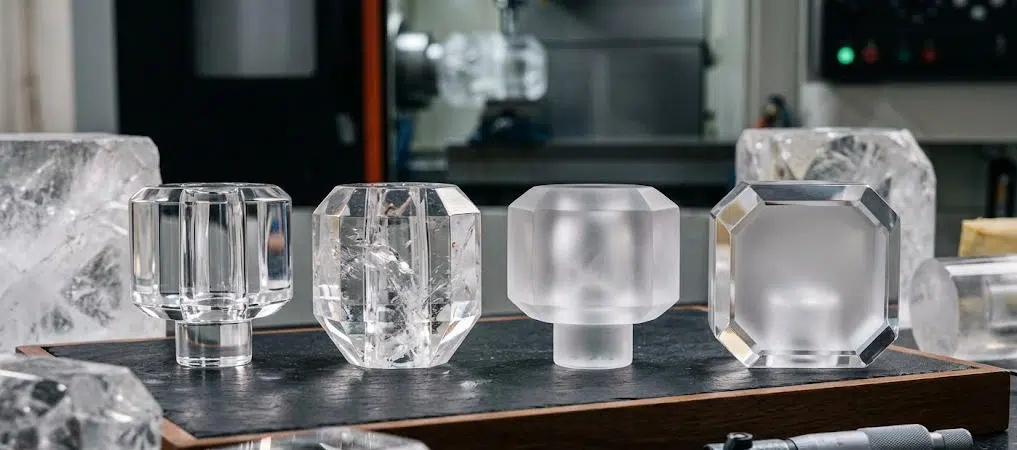
Not every visible feature in a natural crystal cap is something to hide, and treating it that way misses what actually makes a crystal perfume lid wholesale order distinctive on a retail shelf. High-end brands routinely lean into natural texture on purpose, because a faint cloud pattern or a trace of internal graining is proof the piece came from real stone rather than a mold. The surface-finishing decision is where a crystal lid manufacturer either amplifies that authenticity or accidentally draws attention to every flaw the stone has.
Matching Polish Method to Inclusion Type
A high-transparency polish suits clean, high-clarity material well, but it comes with a catch: it makes every remaining internal feature more visible, not less, because light travels straight through the stone with almost nothing to scatter it. Semi-frosted finishing works the opposite way — it softens how light passes through the material, reducing the visual impact of internal texture without hiding the fact that the piece is natural stone. A third option, localized high-polish, mirrors the edges while keeping the center softer, drawing the eye toward the cap’s form rather than into its depth. None of these choices is objectively correct; the right one depends entirely on which grade of material went into that specific part, which loops back to the grading decision made weeks earlier.
Why a Crystal Lid Manufacturer Sometimes Skips High Gloss on Purpose
Here’s the part that surprises a lot of first-time buyers: sometimes the correct move for a crystal cap manufacturer is to recommend against the shiniest, most transparent finish available, even when it’s technically possible. If the material carries visible internal texture, a high-gloss finish shows that texture off more, not less, and a customer inspecting the cap at retail will notice it immediately. So what does that mean for your product line? It means the finish decision should follow from the material grade you’re actually using, not from what looks best in a supplier’s sample photo taken under studio lighting on their single best piece. Ask to see the finish applied to material from the same batch you’re ordering before you commit to a crystal perfume cap wholesale run.
Three Inspection Gates Before a Crystal Perfume Cap Ships: IQC, IPQC, OQC

A single inspection at the end of production catches problems too late to fix cheaply, which is why a serious crystal lid manufacturer checks material at three separate points instead of one. Incoming Quality Control screens raw stone before it enters the workshop at all. In-Process Quality Control checks the piece mid-production, after drilling and CNC work but before finishing. Outgoing Quality Control is the final gate before a shipment leaves the building. Skip any one of these gates, and a defect that could have been caught cheaply early on turns into a finished-goods rejection instead, which costs considerably more in labor and material.
What a Crystal Lid Manufacturer Checks at Each Gate
At IQC, the checks mirror the grading process covered earlier — appearance, dimensional accuracy, crack presence, and light transmission, all assessed before the stone is committed to a specific order. At IPQC, attention shifts to what machining actually did to the piece: whether the bore came out clean, whether CNC edges show chipping, and whether any surface defects appeared during processing that weren’t visible in the rough stone — the exact crystal cap materials risks that IPQC exists to catch early. At OQC, the focus moves to consistency across the batch rather than any single piece: does this crystal perfume lid wholesale shipment look uniform, are there cracks that developed during final handling, and does the assembly fit correctly with the metal or magnetic components it pairs with. Third-party gemological labs like the Swiss Gemmological Institute SSEF apply a comparable staged-verification approach for higher-value stones, which is worth knowing if you ever want independent confirmation on a large crystal perfume cap wholesale order rather than relying solely on your supplier’s internal reports.
This staged approach matters more than it sounds like it should. A crack that forms during drilling and gets caught at IPQC costs you nothing beyond the price of that single blank. The same crack, missed until final packing, costs the labor of every step performed after drilling. So what does that mean for your relationship with a supplier? Asking whether their QC happens at three stages or just one is a fair, specific question — and a vague answer to it is itself useful information.
When an Inclusion Can’t Be Engineered Away

Even with careful grading, orientation, and staged inspection, some stones still come out of processing with a feature nobody planned for. What separates a dependable crystal lid manufacturer from an unreliable one isn’t whether this happens — it happens to everyone working with natural stone — it’s what they do next. There are three honest responses, and none of them involve quietly shipping a flawed piece and hoping nobody notices.
Downgrade, Redesign, or Disclose — the Three Real Options
The first option is downgrading the piece to a use where the flaw doesn’t matter: a cap with reduced transparency doesn’t go on the main display face, it moves to a base or hidden section instead, where the same crystal cap materials risks that would have been a problem up front simply aren’t visible anymore. The second option is redesign — if a batch of intended full-transparency cylinder caps turns out to carry more internal texture than planned, a crystal cap manufacturer might shift the design toward a stone-and-metal frame construction, or lean into the semi-frosted finish covered earlier. The third option, and the one that separates a professional supplier from a corner-cutter, is disclosure: telling you plainly that natural inclusions are expected, that each piece varies slightly, and that minor variation is normal for genuine stone rather than a manufacturing defect.
What a Crystal Lid Manufacturer Should Put in Writing Before You Sign an Order
No honest crystal lid manufacturer should tell you a crystal perfume lid wholesale order will arrive “100% inclusion-free,” because that promise isn’t achievable with genuine natural stone. What you should ask for instead is a written acceptance standard — a document specifying exactly what counts as acceptable natural variation for your order and what gets rejected outright. This matters for cost as much as for quality: a supplier without a written standard tends to negotiate acceptability case by case after your goods have already shipped, which is a slower and more expensive way to resolve a dispute than settling it before production starts. Get the acceptance criteria in writing, specific to your crystal perfume cap wholesale order, before the first stone is cut.
Material Acceptance Standards a Crystal Lid Manufacturer Uses for Luxury Perfume Brands

If your buyers are luxury perfume houses, niche fragrance labels, or high-end OEM clients, the acceptance bar for a crystal cap manufacturer typically sits higher than standard wholesale terms, and it should be spelled out before production rather than negotiated after the fact. This is where the earlier grading, orientation, drilling, and finishing decisions all converge into a single written standard both sides sign off on.
What Gets Accepted, What Gets Rejected
For this tier of order, the accepted range typically includes small natural texture, light internal cloudiness, and minor inclusions that don’t compromise the structure — features that gemological references, including GIA’s clarity typing framework, already treat as normal for natural material rather than as defects. The rejected range is narrower: cracks that penetrate all the way through the piece, any inclusion sitting inside the drilling zone itself, large dark mineral spotting, and anything that visibly interferes with the design’s intended transparency. Writing this distinction down, rather than leaving it as a verbal understanding, is what turns a crystal lid manufacturer relationship from a series of one-off negotiations into a repeatable process you can scale a crystal perfume lid wholesale program around — and it’s precisely how a serious supplier manages crystal cap materials risks at scale instead of case by case.
There’s a cost dimension here too. A documented standard shortens the back-and-forth on borderline pieces during OQC for a crystal perfume cap wholesale run, and that time saved shows up directly in your lead time and in fewer disputed-unit deductions on your invoice. A crystal cap manufacturer that hesitates to put standards in writing is telling you something about how disagreements get resolved later.
Quick Answers for Buyers Comparing a Crystal Lid Manufacturer

Before you request a quote from a crystal lid manufacturer, a few questions come up often enough that they’re worth answering directly rather than making you dig for them.
What This Process Adds to Your Unit Cost
Grading rough stone, orienting every cut, drilling in multiple slow stages, and running three inspection gates all take more time than a single-pass process would. That time shows up in your quote as a modest per-unit premium over a factory skipping some of these steps — but it shows up again, in reverse, on your reject rate and your return-shipment costs. A crystal perfume lid wholesale buyer who compares two quotes purely on unit price, without asking what QC stages are included, is often comparing a controlled process against an uncontrolled one without realizing it. The cheaper quote on paper can end up costing more once you account for units that fail inspection on your end instead of the factory’s.
How to Start a Trial Order With a Crystal Lid Manufacturer
The practical first step is smaller than most buyers expect: request a written material acceptance standard alongside a trial batch, rather than a full production run on the first order. A trial batch lets you see how a crystal cap manufacturer actually grades, orients, and finishes material against your specific design before you commit volume to a crystal perfume cap wholesale contract. If a supplier resists putting acceptance criteria in writing before a trial, or can’t explain their grading system when you ask, that response tells you as much about crystal cap materials risks on a future large order as any sample piece could.
A Short Note on Where This Process Comes From
Stone Elf has spent more than a decade cutting, drilling, and finishing natural crystal and jade perfume caps and bottle components, and the sequence above — grading, orientation, staged drilling, dynamic CNC adjustment, three-gate inspection, and written acceptance standards — is the same one running on the floor day to day. If you’re evaluating a crystal lid manufacturer for an upcoming crystal perfume lid wholesale or crystal perfume cap wholesale order, the acceptance-standard document covered above is a reasonable place to start the conversation, and it’s one we’re glad to walk through against your specific design.