
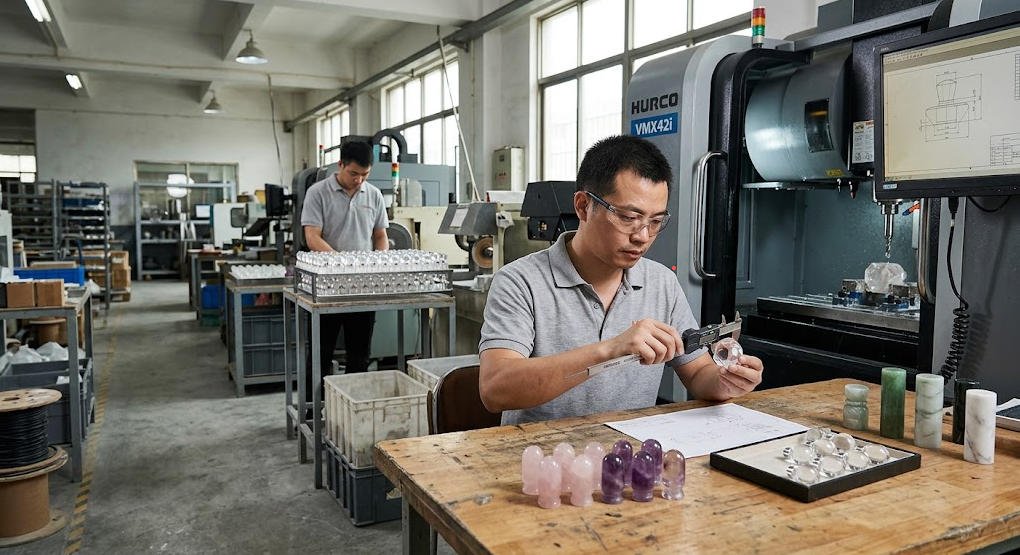
If you’ve asked two or three suppliers for a crystal cap custom quote on the same design and gotten numbers that don’t line up at all, you’re not imagining things. The gap usually has nothing to do with someone padding a margin. It has to do with where your order sits on a cost curve that most buyers never actually see on paper. Inside one real 2026 factory cost sheet, the fixed setup cost behind a single custom stone-cap production run — 3D modeling, tooling, first-article testing, everything that happens before a stone is even cut — came out to roughly $300. Spread across 50 pieces, that adds $6 to every single unit before material or labor is counted. Spread across 500 pieces, it drops to $0.60. That is not a sales tactic. It’s division. This article walks through why 500 pieces keeps showing up as the point where the math starts working in your favor, and what you’re actually exposed to if you order well below it.
The Fixed-Cost Curve Behind Every Crystal Cap Custom Quote
Before a single piece of rough stone touches a cutting wheel, a crystal lid factory has already spent money on your order. 3D modeling and design-for-manufacture (DFM) review happen first, followed by CNC programming, jig and fixture preparation, drilling-parameter testing, first-sample production, raw material screening, a round of polishing trials, packaging development, and the paperwork that sets your QC standard. None of that work scales down just because your order does. A factory doesn’t spend less time writing a CNC program for 80 pieces than it does for 800 — the program is the program.
That’s the part buyers underestimate most. You could be requesting 100 caps or 1,000 caps and the setup phase looks almost identical on the shop floor. What changes is how many finished units eventually absorb that one-time cost. This means your quoted unit price at 100 pieces is still carrying nearly the same fixed bill as your unit price at 500 pieces — you’re just dividing $300 by a much smaller number, and the math punishes you for it.
What Happens Before Every Crystal Cap Custom Order Is Cut
Nine separate steps typically sit between “the design is agreed” and “production actually starts”: 3D modeling and DFM review, CNC programming, tooling and fixture setup, drilling-parameter testing, first-article sampling, raw material screening, polishing-process testing, packaging development, and QC-standard documentation. Each one takes real hours from an engineer, a machinist, or a quality technician at a crystal perfume cap manufacturer, and none of them touch a per-piece budget line — they sit entirely on the fixed-cost side of the ledger. If you’ve ever wondered why a 50-piece custom sample run can cost almost as much per unit as ten times that quantity, this is the answer sitting in plain sight.
A Real 2026 Quote, Broken Down to the Dollar
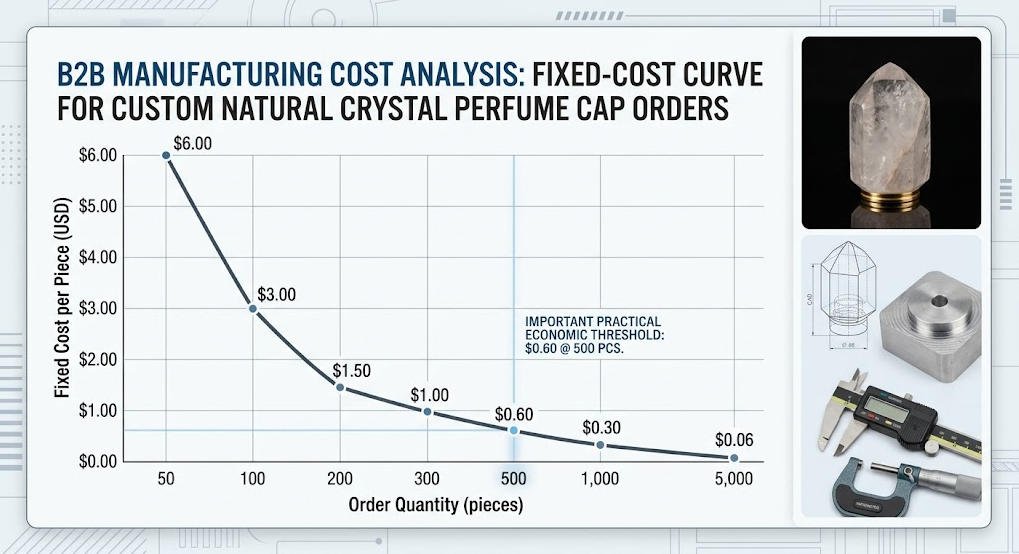
One documented internal quotation from 2026 put the combined tooling, sampling, and pre-production cost for a new crystal cap custom design at approximately $300. Divide that figure across different order sizes and the pattern becomes hard to argue with:
| Order Quantity | Fixed Cost per Piece |
|---|---|
| 50 pcs | $6.00 |
| 100 pcs | $3.00 |
| 200 pcs | $1.50 |
| 300 pcs | $1.00 |
| 500 pcs | $0.60 |
| 1,000 pcs | $0.30 |
| 5,000 pcs | $0.06 |
Between 50 pieces and 500 pieces, the fixed-cost burden on each unit falls by roughly 90%. This is exactly the phenomenon economists label economies of scale — the observation that as output rises, per-unit production costs decline because fixed costs get spread over more units (Wall Street Prep, 2024). This means the price difference you see between a 100-piece and a 500-piece quote isn’t a supplier being generous at higher volume. It’s the same fixed cost getting divided by a bigger number, and you benefit either way the math falls. Buyers sourcing through a crystal perfume lid wholesale channel typically see this same curve reflected in quoted unit prices, even before packaging is added on top.
Natural Stone Doesn’t Behave Like Injection-Molded Plastic in Crystal Cap Custom Production
A resin or zinc-alloy perfume cap can be modeled almost perfectly in advance because the material is uniform. Crystal, agate, and jade caps can’t be modeled that way, and this single fact changes almost every cost assumption a buyer might bring in from working with synthetic materials. Every rough stone carries its own internal variation, and a crystal perfume cap manufacturer has to plan around that variation rather than around a fixed specification sheet. That single fact is what separates a crystal lid factory from a standard plastics or metal-cap production line, and it’s the source of most of the cost differences buyers don’t expect when they first move from synthetic materials to natural stone.
Gemological research backs this up directly. The Gemological Institute of America notes that natural stones commonly contain internal features such as needles, clouds, fluids, and crystals — the same characteristics gemologists rely on to distinguish natural material from synthetic (GIA, 2025). Those same features are exactly what a factory has to screen out during raw material selection for a crystal cap custom order, and screening takes both time and stone.
Why 40 Grams of Rough Doesn’t Become 40 Grams of Finished Cap
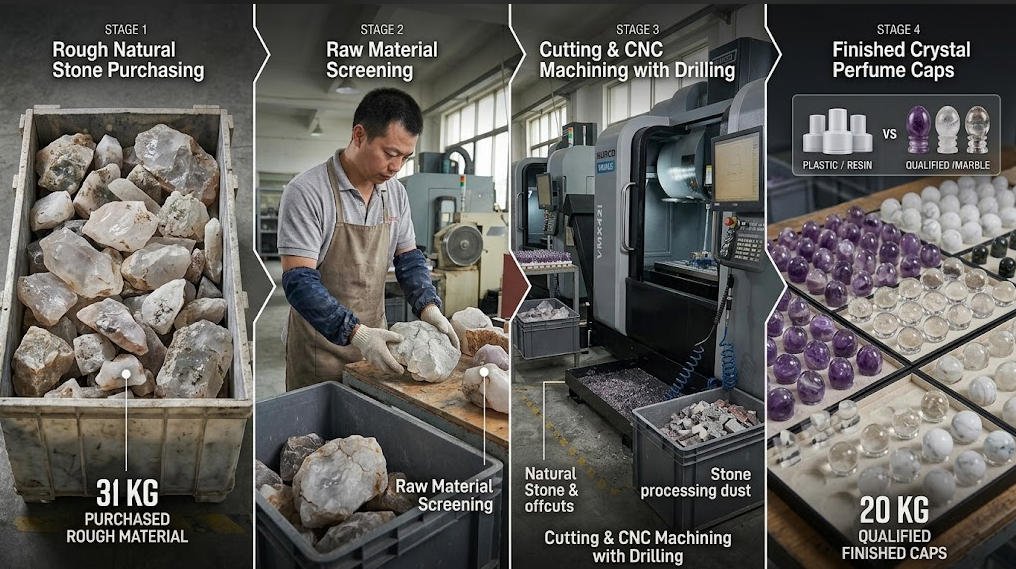
Assume a finished cap needs roughly 30–50 grams of qualified rough stone — call it 40 grams as a working average. An order of 500 pieces at 40 grams each theoretically needs about 20 kilograms of finished material. But a factory can’t simply buy 20 kilograms of rough and expect it all to survive the process. Cracks, inclusions, color variation, cloudy zones, internal structural flaws, and undersized pieces all get rejected before cutting even starts, and additional material is lost during cutting, CNC shaping, and drilling. Production data from years of processing this material puts the realistic material yield at around 65% — meaning only 65% of the rough stone purchased ends up as a usable, finished piece, and the remaining 35% is scrapped along the way. Run the math backward and a 500-piece order at 40 grams per cap actually requires close to 31 kilograms of purchased rough, not 20.
This means your quoted material cost isn’t inflated — it reflects roughly a third of what you’re paying for in raw stone never making it into your hands as a finished product. That’s not a markup. It’s physics and geology showing up on an invoice.
The Sourcing Minimum Problem for Small Orders
Rough-stone suppliers also tend to set their own minimum purchase quantities, and this compounds the yield problem for small buyers. If your order only needs 50–100 pieces, a crystal lid factory may still be forced to buy an entire batch of rough stone to get consistent color and grain, leaving leftover material that can’t be used immediately and effectively becomes inventory the factory is carrying on your behalf. Once an order reaches roughly 500 pieces, raw material purchasing starts to line up naturally with supplier batch sizes, and per-gram pricing tends to stabilize rather than spike. This pattern repeats across most crystal perfume lid wholesale supply relationships, where batch-sized purchasing simply works better for everyone involved. So what does that mean for you? At smaller volumes, you’re often quietly subsidizing stone that never becomes your product — you just don’t see that line item written down anywhere.
Yield Rate Is a Numbers Game in Crystal Cap Custom Production, and Small Orders Lose It
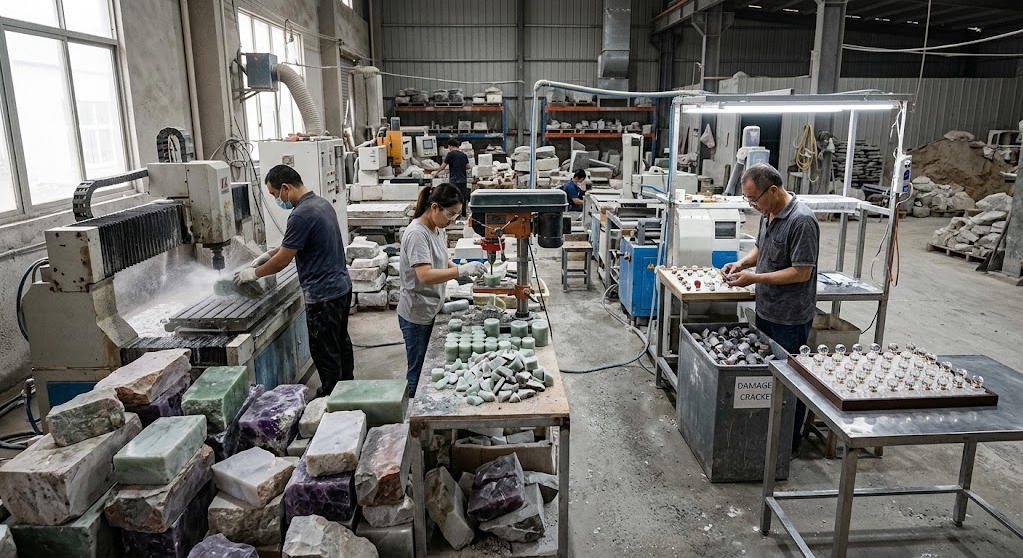
Manufacturing yield on a natural-stone cap isn’t decided by one step — it compounds across several. A crystal cap custom order passes through rough shaping, CNC forming, center drilling, and fine polishing, and each stage carries its own pass rate. A representative sequence looks like this: rough shaping at roughly 90%, CNC processing at roughly 95%, center drilling at roughly 90%, and fine polishing at roughly 95%.
How a 73% Combined Yield Is Calculated
Multiply those four rates together — 0.90 × 0.95 × 0.90 × 0.95 — and the combined yield lands at approximately 73%. That single number has real consequences for order planning. To deliver 100 finished, approved pieces, a crystal perfume cap manufacturer typically needs to start with around 137 raw workpieces. To deliver 500 finished pieces, that number rises to roughly 685 starting pieces. The ratio stays the same either way, but the absolute buffer a small order can tolerate does not.
Case Study: When One Cracked Piece Sinks a Small Crystal Cap Custom Order
Consider a composite scenario drawn from recurring patterns across small-batch orders at a crystal lid factory: a buyer requests 120 finished jade caps, and the factory begins with roughly 165 raw workpieces based on the 73% yield model. A drilling error or an unexpected internal crack in a handful of pieces during processing removes 6 pieces from the batch — a routine variance well within statistical expectation. On a 685-piece starting batch bound for 500 finished units, losing 6 pieces barely registers. On a 165-piece starting batch bound for 120 finished units, that same 6-piece loss can push the delivered quantity below what the buyer actually ordered, forcing a second, smaller production run to close the gap — and a second run means paying setup-adjacent costs twice. This means the smaller your order, the less room you have to absorb a single bad drilling pass or a single cracked stone, and the more that one event can derail your entire delivery timeline.
The Line Switch: From Sample Mode to Batch Mode in Crystal Cap Custom Manufacturing
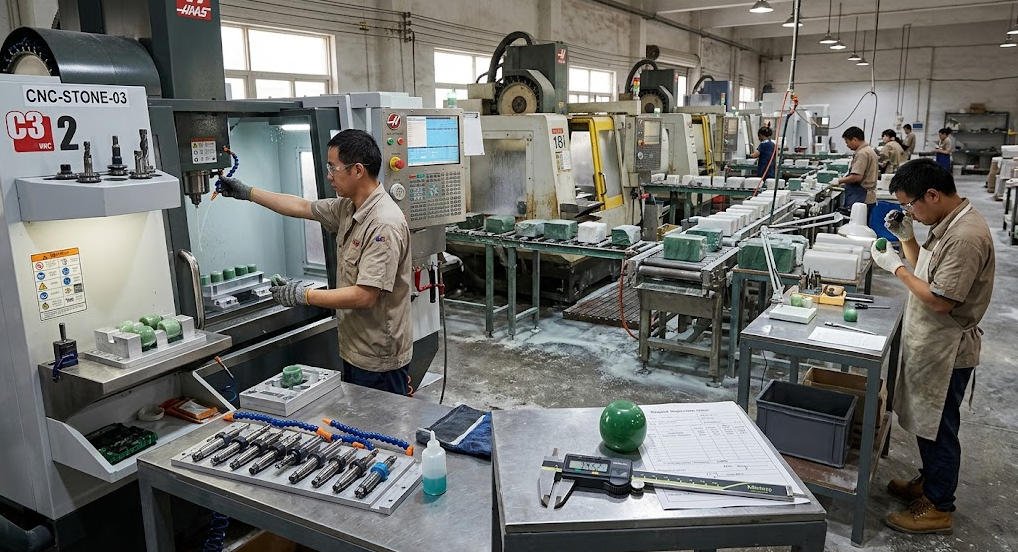
A custom stone cap typically moves through cutting, rough grinding, shaping, CNC processing, drilling, fine polishing, buffing, cleaning, and final QC. Before any of that starts, the line has to be set up — machines adjusted, fixtures swapped, CNC programs loaded, tooling changed, drilling parameters tested, a first article confirmed, and polishing settings dialed in. Here’s the part that surprises most buyers: the setup work for 100 pieces and the setup work for 500 pieces is nearly identical. The difference isn’t in preparation time — it’s in how many units that preparation time gets divided across.
Setup Time Doesn’t Shrink Just Because the Order Does
Internal production data illustrates the effect clearly. A 100-piece crystal cap custom order averages around 15 days from start to finish. A 500-piece order averages around 20 days. A 3,000-piece order averages around 30 days. At first glance, that looks like larger orders simply take longer — and they do, in absolute terms. But convert those figures into hours per finished unit and the real story appears.
Time-per-Unit Data Across Three Order Sizes
At 100 pieces, 15 days of production works out to roughly 3.6 hours per finished piece. At 500 pieces, 20 days works out to roughly 0.96 hours per piece. At 3,000 pieces, 30 days works out to roughly 0.24 hours per piece. The larger the order, the less time — and therefore less labor cost, less machine time, and less electricity — each individual piece consumes. So what does that mean for your quote? A larger order isn’t just cheaper per unit because of material pricing. It’s cheaper because every hour of machine and labor time is being divided across more finished caps, and that ratio keeps improving well past the 500-piece mark.
Packaging Minimums Nobody Mentions Until Your Crystal Cap Custom Invoice

Brand-ready delivery almost always involves more than the cap itself. Custom rigid boxes, EVA inner trays, foam inserts, velvet pouches, printed logos, labels, barcodes, and shipping cartons all sit downstream of production, and each one comes with its own supplier relationship — and its own minimum order quantity.
Why an EVA Insert Supplier Won’t Touch 100 Units
Custom EVA insert production frequently carries a minimum order quantity well above what a small buyer actually needs. If your order calls for 100 finished caps, the packaging supplier may still require a run of 500 or even 1,000 insert units to justify tooling their own die-cutting equipment, leaving the surplus as unused inventory sitting somewhere in a warehouse. Across most crystal perfume lid wholesale supply chains — including the packaging partners that a crystal lid factory works with rather than manufactures in-house — a single packaging production run rarely gets scheduled below roughly $300 in total value. That constraint alone tends to push a buyer’s realistic minimum order size toward 500 pieces, because that’s the point where packaging cost per unit stops looking disproportionate to the product itself. This means if you’re pricing packaging separately from your cap order, you’re likely missing where a large share of your small-batch premium is actually coming from.
Labor Continuity and the Real Cost of Switching Jobs
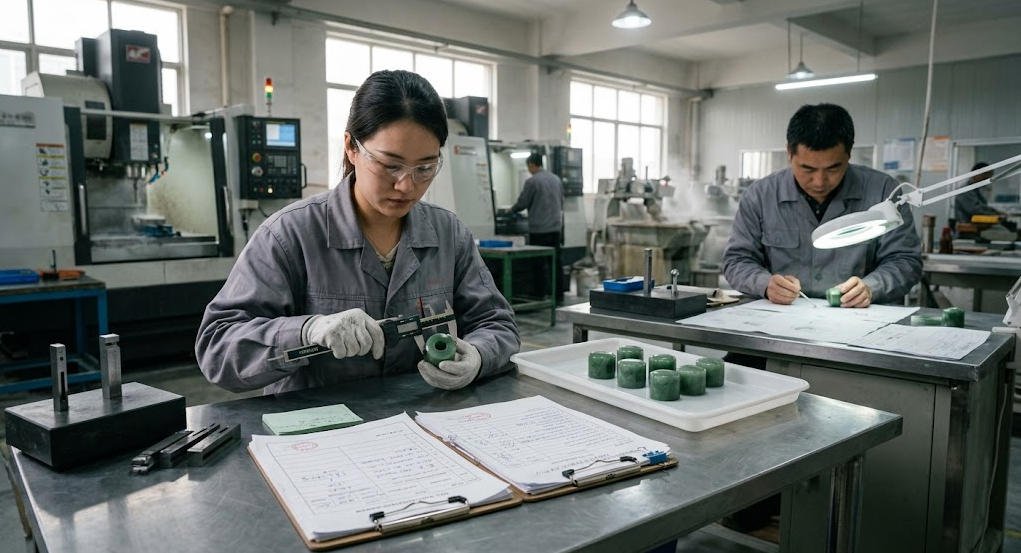
Beyond the machines, an order like this depends on a sequence of manual steps: sorting rough stone, checking for cracks, positioning pieces for machining, loading and unloading equipment, measuring finished dimensions, inspecting polish quality, cleaning, and sorting finished units. None of this is automated end-to-end, and every one of those steps takes a technician’s full attention. Every crystal perfume cap manufacturer relies on this kind of continuity to keep quoted labor rates accurate rather than approximate.
Small orders in the 50–100 piece range often force workers to switch between different materials, specifications, and problem-solving tasks multiple times a day, and every switch costs setup time that never shows up as a line item. A 500-piece order, by contrast, tends to settle into a single continuous rhythm — same material, same specification, same program, same process, run back to back without interruption. That continuity is what actually drives down labor time, equipment time, and supervision cost per unit, more than any single piece of machinery does. So what’s the practical takeaway? A crystal lid factory quoting you a lower labor rate at 500 pieces isn’t cutting corners — it’s running a job that finally lets a technician stay in one motion instead of resetting eight times a day.
So Why 500, and Not 100? A Tier-by-Tier Crystal Cap Custom Comparison
None of the individual factors above are dramatic on their own. Stacked together, they explain why factories consistently treat 500 pieces as a reference point rather than an arbitrary round number.
| Quantity | Factory-Side Reality | Economic Character |
|---|---|---|
| 1–50 pcs | Sampling / trial production | Fixed cost extremely high per unit |
| 50–100 pcs | Micro-batch | Unit price typically steep |
| 100–300 pcs | Small custom batch | Workable, but efficiency stays low |
| 300–500 pcs | Economics start improving | Entering a more reasonable range |
| 500–1,000 pcs | Stable small-scale production | Fixed cost meaningfully diluted |
| 1,000–5,000 pcs | True batch production | Scale economies become visible |
| 5,000+ pcs | Large-scale run | Per-unit manufacturing cost drops further |
Notice that the jump from 100 to 500 pieces isn’t simply “five times the order.” It’s a shift in how the entire supply chain treats your job — from something a crystal perfume cap manufacturer has to specially prepare for, to something that fits inside an existing rhythm of batch-scale purchasing, tooling, and labor allocation. The same pattern shows up across crystal perfume lid wholesale negotiations, where packaging partners tend to apply nearly identical volume breakpoints of their own.
Compliance, Certification, and What “Risk Disclosure” Actually Means Here
None of the cost mechanics above matter much if the finished product can’t clear quality inspection or customs review once it reaches you. This is where documentation, not marketing language, does the real work of protecting a buyer.
ISO 9001 and Why Documentation Matters More Than Marketing Claims
ISO 9001:2015 is the internationally recognized standard for quality management systems, and it exists specifically to give organizations — and their customers — a documented, auditable process for consistent output. According to ISO’s own explanation of the standard, it provides a framework that helps organizations deliver consistent products and services (ISO, 2026). For a crystal lid factory, that means every stage described earlier — first-article sampling, drilling-parameter testing, polishing trials, QC-standard documentation — should exist as recorded, repeatable procedure rather than as something explained verbally after the fact — the same standard reputable crystal perfume lid wholesale suppliers are expected to meet further downstream. If a supplier can’t produce documentation showing how a defect rate or a yield percentage was actually measured, treat that as a gap worth asking about directly, not a detail to skip past.
Questions Worth Asking Before You Sign a Small-Batch Contract
Before confirming any crystal cap custom order, especially below the 500-piece mark, it’s worth asking a supplier directly what their documented yield rate is by process stage, whether their packaging partners have published minimum order quantities, and whether their fixed setup cost is itemized separately from per-piece material and labor cost, and whether you’re dealing with a genuine crystal perfume cap manufacturer or a trading company reselling someone else’s output. A supplier that can answer all four with actual numbers is operating closer to the ISO 9001 documentation standard than one who answers only with a single bundled unit price. That distinction matters more at small quantities, where a single unclear cost assumption has the most room to distort your final invoice.
How to Plan a Crystal Cap Custom Order Size That Doesn’t Waste Your Budget
If you’re deciding between a 150-piece test order and holding out for 500, the decision doesn’t have to be a guess. A few concrete steps make the comparison much clearer before you request a formal quote.
- Ask your supplier to itemize fixed setup cost separately from per-piece material and labor cost, so you can see exactly what a smaller order is absorbing.
- Request the documented material yield rate for your specific stone type, since agate, jade, and quartz don’t all behave identically under CNC and drilling.
- Confirm packaging minimum order quantities with your crystal perfume lid wholesale packaging partner before finalizing cap quantity, since a mismatch here often becomes the hidden cost that surprises buyers late in the process.
- Compare quoted lead time against the volume tiers above — if your 200-piece quote takes almost as long as a 500-piece run, that’s a signal the setup phase is dominating your timeline.
Following that sequence won’t force every order up to 500 pieces, and it shouldn’t — some designs genuinely call for a small trial run first. This means you’ll at least know exactly which cost you’re paying for at 150 pieces, instead of assuming it’s the same math as an order three times the size.
Three Stages, One Supply Chain
Every custom order like this effectively lives in one of three cost postures. Below roughly 500 pieces, the honest framing from a crystal lid factory‘s side is: this order requires a full round of dedicated preparation. Around 500 pieces, that framing shifts to: the preparation cost is now spread reasonably across the batch. Above roughly 1,000 pieces, it shifts again to: production is organized around genuine batch-manufacturing logic rather than one-off setup. None of these stages is inherently right or wrong for a given buyer — a first-time product launch may need the small-batch stage regardless of unit economics. But knowing which stage your order actually sits in changes what questions are worth asking, and what price differences are worth pushing back on.
Conclusion: 500 Pieces Is a Cost Threshold, Not a Production Rule
500 pieces isn’t a rule written down anywhere in crystal cap custom manufacturing, and no factory is technically incapable of producing fewer. What makes it a meaningful reference point is that raw material sourcing minimums, natural-material yield loss, CNC and drilling line-switching cost, polishing labor continuity, packaging MOQs, and QC documentation cost all happen to compress around the same order size at roughly the same time. A 100-piece order and a 500-piece order aren’t simply “five times the quantity” of each other — they sit on different sides of a point where an entire supply chain shifts from sample-batch logic to production-batch logic. That’s the real reason 500 pieces keeps showing up as a benchmark across crystal perfume cap manufacturer quotations, crystal lid factory production planning, and crystal perfume lid wholesale packaging negotiations alike — not because someone decided it should be, but because the underlying cost curve keeps landing there.
Disclaimer: This article was prepared by a manufacturer operating in the crystal, jade, and natural-stone perfume cap industry, based on internal production and costing data alongside publicly available third-party sources. It is intended as general industry and cost-disclosure information, not as a specific quotation, guarantee, or professional advisory service. Actual costs, yield rates, and lead times vary by stone type, design complexity, supplier, and order specification, and prospective buyers should request itemized quotations for their own designs before making purchasing decisions. Every reasonable effort has been made to present this information objectively rather than promotionally.
References
- Gemological Institute of America (GIA). “The Big Deal about Little Inclusions.” 4Cs.gia.edu, 2025. https://4cs.gia.edu/en-us/blog/big-deal-little-inclusions/
- International Organization for Standardization (ISO). “ISO 9001 Explained.” iso.org, 2026. https://www.iso.org/home/insights-news/resources/iso-9001-explained.html
- Wall Street Prep. “Economies of Scale (EOS) | Definition + Examples.” 2024. https://www.wallstreetprep.com/knowledge/economies-of-scale/
- Corporate Finance Institute. “Economies of Scale.” https://corporatefinanceinstitute.com/resources/knowledge/strategy/economies-of-scale
- Internal factory costing and production-time records, 2026 (unpublished client quotation data, referenced in aggregate).