

Every crystal perfume cap custom order starts with the same assumption: if the factory follows the reference image, the finished caps will look right. In practice, that assumption breaks down the moment natural stone enters production. A single batch of 500 caps cut from the same quartz variety can show a 10 to 15 percent shift in tone between the first tray and the last, even when every unit passes dimensional inspection with a caliper. That gap between “technically correct” and “visually correct” is exactly where custom orders go wrong, and it is exactly what a golden sample exists to close. If you are sourcing caps for a fragrance line, you are not only buying a shape — you are buying a visual promise behind every crystal perfume cap custom order, and you need a physical object that holds a factory to that promise, batch after batch.
Table of Contents
What Actually Defines “Correct” in a Crystal Perfume Cap Custom Order
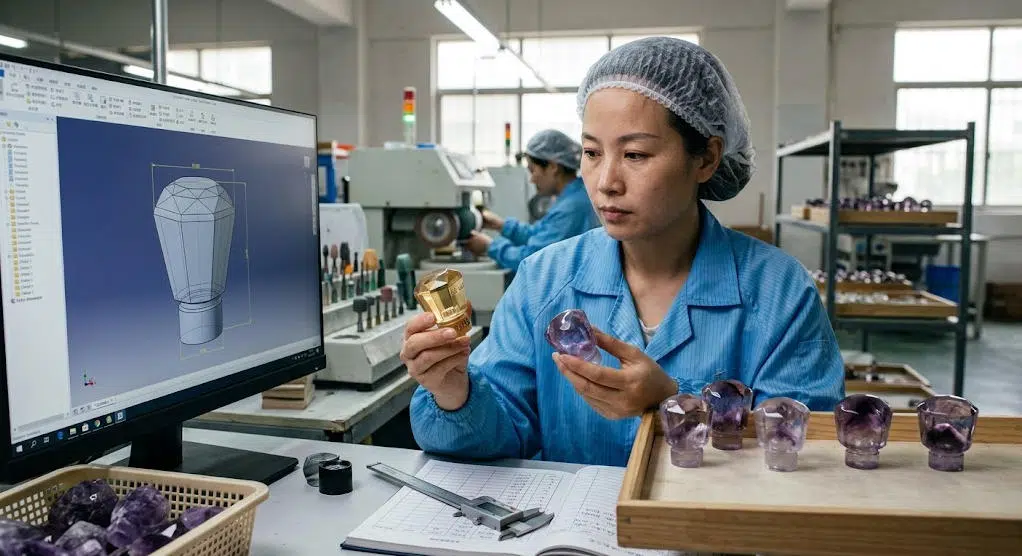
Renderings, 3D files, and Pantone references are useful for design approval, but they were never built to survive contact with a cutting wheel. A rendering fixes one lighting angle and one screen’s color calibration, while a finished cap sits under warehouse light, retail light, and a customer’s bathroom light, often on the same day. That difference is where a crystal perfume cap custom order can start drifting before a single stone reaches the lathe.
Word choices carry the same risk. When you ask for “light purple, fairly transparent amethyst,” you are describing a feeling rather than a measurement. A cutter reading that sentence may picture a paler stone, or a noticeably deeper one, and both readings feel reasonable from where each person is standing. Two teams can agree completely on a written brief and still be building toward two different results.
Renderings vs. Physical Standards: Where the Gap Begins
Descriptive words such as “clean,” “bright,” or “refined” carry no fixed numeric value, and that is not a flaw unique to this industry. Even formal colored-gemstone grading, as documented by the International Gem Society, depends on comparison against known reference material rather than adjectives alone, because verbal description cannot reliably separate one grade of clarity from the next. A crystal cap manufacturer working only from a paragraph of adjectives is being asked to guess where you would personally draw that line.
You can close that gap by shifting the standard from language to an object. A golden sample removes the guesswork because it is not a description of a target — it becomes the target itself. This means your production supervisor never has to decide what “refined” means; the only decision left is whether today’s tray sits close enough to the object already sitting on the shelf.
How a Golden Sample Turns a Brief Into a Crystal Perfume Cap Custom Standard
Once you sign off on a physical sample, that object becomes the working definition of “correct” for everyone downstream — cutters, polishers, QC staff, and you. A crystal perfume cap custom order built around an approved object, rather than a paragraph of description, gives every person on the line the same reference point at the same time. That matters more than it sounds, because a factory floor running two or three shifts cannot pass adjectives down the line without losing precision at every handoff, whether the run is a small custom batch or a full crystal perfume cap wholesale shipment.
This also shortens the approval cycle in a way that rarely gets mentioned upfront. When a disagreement happens later, both sides can point to the same physical object instead of arguing over what a sentence was originally supposed to mean.
The Real Challenge Behind Every Crystal Cap Manufacturer’s Quality Control
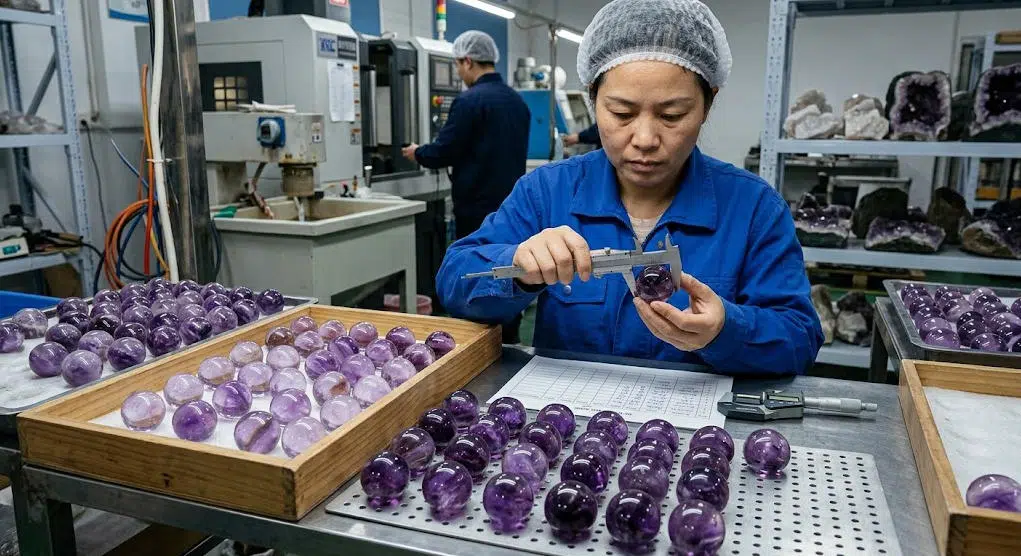
Resin and ABS caps come from a mold and a fixed color batch, so 500 units from one run can be nearly identical to each other. Natural quartz does not behave that way, and no crystal cap manufacturer can change that fact through better equipment alone. Rose quartz, amethyst, and clear quartz each carry variation that was already built into the rough stone long before cutting starts.
Even within a single rough block, color depth shifts from one end to the other, tone leans warmer or cooler depending on trace minerals, and clarity changes as inclusions cluster differently through the material — exactly the variable every crystal perfume cap custom buyer needs to plan around. GIA’s own gem encyclopedia entry on amethyst notes that the variety forms in large six-sided crystals with color ranging from pale lilac to deep purple, sometimes within gems mined from the same general deposit. That range is not a defect. It is simply how the mineral grows in nature.
Why Natural Crystal Cannot Be Copied Like Resin or ABS
A CAD file reproduces 500 times with no meaningful variation, because a CAD file describes geometry, not material. Rough quartz cannot be reproduced at all — every block is unique, and even adjacent sections of one block behave differently once cut and polished. This is the core reason a crystal lid custom order behaves so differently from a resin lid program built off the exact same drawing.
For your production plan, this means natural variation should be treated as a starting condition rather than a manufacturing error waiting to be eliminated. The realistic target is managing that variation inside a range you have already approved, not chasing a uniformity that natural stone was never going to deliver in the first place.
Dimensional Tolerance Is Not Visual Consistency
Here is a distinction that catches many buyers off guard: a batch can pass every dimensional check — outer diameter, height, and bore diameter all within tolerance — and still show visible color and clarity differences from one unit to the next. Measurement tools confirm size. They say nothing about whether a cap looks like it belongs beside the one sitting next to it on a retail shelf.
This is exactly why sizing specifications and appearance specifications need to run as two separate systems inside any crystal perfume cap custom relationship with a crystal cap manufacturer. One gets solved with calipers and a 2D drawing. The other needs a different kind of reference entirely, which is precisely the gap a golden sample was designed to fill.
The Golden Sample as a Visual Anchor Across Crystal Perfume Cap Wholesale Production
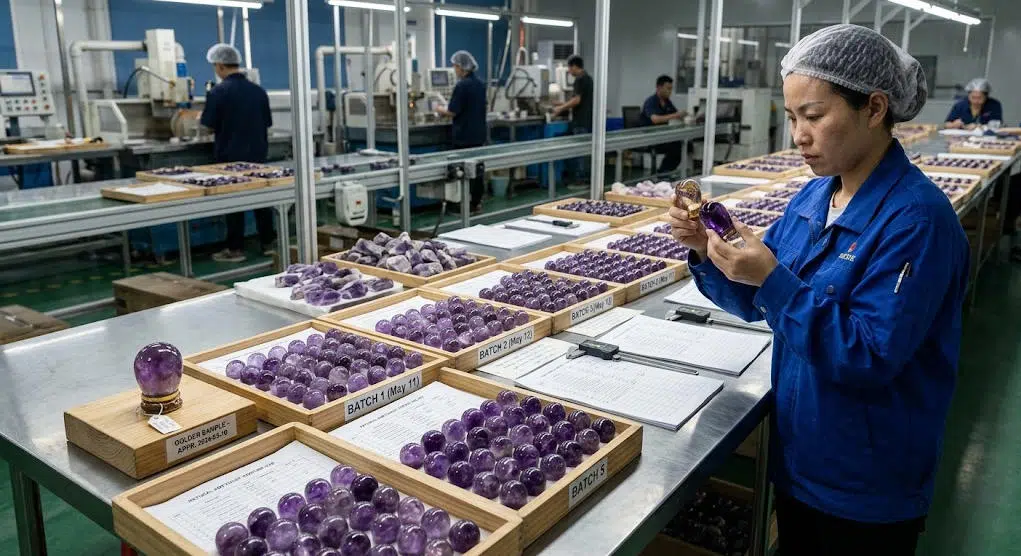
The most common failure in large-volume runs is rarely an obvious defect anyone can spot right away. It is quieter than that: everyone on the line genuinely believes they are matching the standard, while each person’s internal idea of “matching” has drifted slightly from everyone else’s. Across a crystal perfume cap wholesale order running several production days, that quiet drift compounds fast.
Picture a simple approval note: “a little deeper than the sample is fine.” One operator reads that as a 5 percent shift, the next reads it as 10 percent, and by the third tray the color has moved 20 to 30 percent away from what you originally approved — while each individual batch, viewed on its own, still looks reasonable to whoever produced it. Nobody did anything obviously wrong, yet the finished shipment barely resembles the sample you signed off on weeks earlier.
How Small Deviations Compound Batch After Batch
Small, individually tolerable deviations accumulate into a large aggregate deviation whenever there is no fixed anchor resetting the comparison at each stage. A crystal perfume cap custom program without a golden sample has no such anchor, so drift is free to build up unchecked from the first tray to the last.
A golden sample interrupts that chain directly. Instead of comparing today’s tray to yesterday’s tray, which is exactly how drift creeps in unnoticed, your QC team compares today’s tray back to the original approved object every single time. The comparison never loses its reference point, regardless of how many days or shifts the run spans.
Turning Subjective Judgment Into an Objective Comparison
Without a shared object, “does this look right” is a matter of opinion, and opinions shift by person, by lighting, and by how tired someone feels near the end of a Friday shift. With a golden sample sitting on the QC bench, the question changes from “does this look right to me” into “does this match the object we already agreed on.” That is a meaningfully more defensible question for any crystal perfume cap custom order running at real volume.
Doesn’t it make more sense to settle that question once, at approval, rather than re-litigating it every single production day? Fewer disputes reach you as the buyer this way, and the ones that do arrive already carrying a physical comparison, not just a verbal disagreement between two people who each believe they are right.
Quantifying “Beautiful” in a Crystal Perfume Cap Custom Order
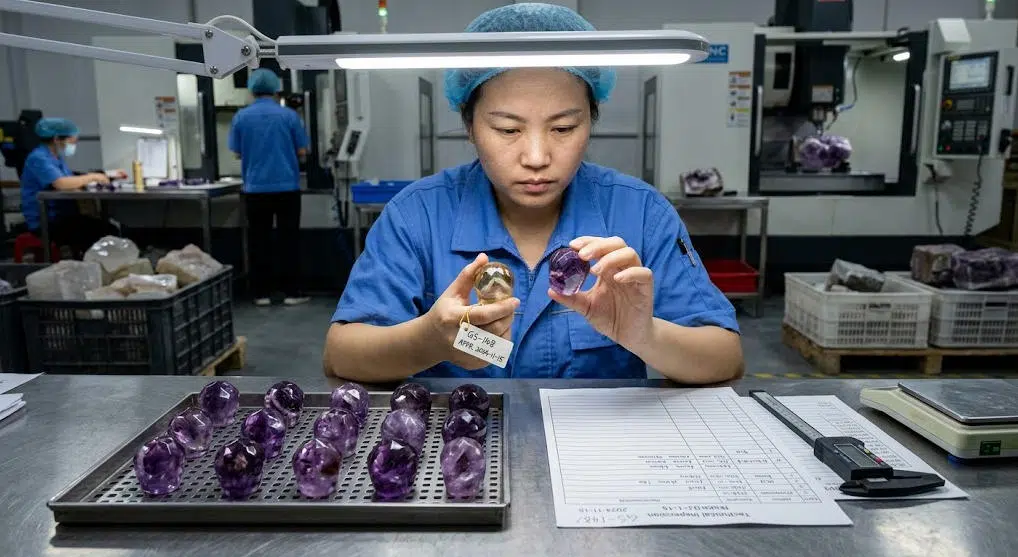
Some specifications on a crystal cap are easy to put a number on. Outer diameter, height, bore diameter, weight, and insert-fit dimensions can all be measured with calipers and stated as a tolerance on a drawing. Color, transparency, internal texture, and overall visual character resist that kind of precision, no matter how carefully a written brief tries to describe them for a crystal perfume cap custom order.
Take a request like “not too much cotton,” a common note on crystal lid custom orders using amethyst or rose quartz. The real question hiding inside that sentence is: how much actually counts as too much? Without a shared reference, you might view a certain density of inclusions as a flaw, while the factory views the same density as a normal feature of natural stone that has never caused a customer complaint before. Neither side is wrong here — you are simply working from two different internal thresholds.
Measurable Specs vs. Visual Specs in Crystal Lid Custom Production
A useful way to think about this is splitting every specification into two buckets. Bucket one covers anything a caliper, scale, or gauge can confirm, including dimensions, weight, and insert tolerance. Bucket two covers anything that depends on the human eye, including color, clarity, surface finish, and the overall visual impression buyers usually describe as “clean” or “refined” character. Bucket one belongs on a 2D drawing; bucket two belongs on a golden sample.
- Dimension bucket: outer diameter, height, bore diameter, weight, insert fit
- Appearance bucket: color, transparency, internal texture, polish, overall visual character
Whether you are locking dimensions for a crystal lid custom drawing or approving color on a batch of amethyst, keeping these two buckets separate stops one from quietly overriding the other. For any crystal perfume cap custom order, your specification package should never be a single document. It should pair a drawing for what can be measured with a physical object for what cannot, working together instead of one trying to substitute for the other.
How Much Inclusion Is “Too Much”? A Real-World Example
If the approved golden sample itself carries a small, visible degree of natural inclusion, that object is quietly telling your crystal cap manufacturer something important: this level of texture already has your approval. There is no ambiguity left to argue over once that object exists, because the acceptable degree of “cotton” is no longer a judgment call — it is sitting on the shelf in physical form.
What happens without that reference in place? Every unit near the threshold turns into a negotiation, repeated across every batch and every shift for the life of a crystal perfume cap custom order. That is a slow, expensive way to run a production line, and it is entirely avoidable with one signed object at the start.
Setting the Acceptable Range — and Preventing Moving-Target Approvals — in Crystal Perfume Cap Custom Orders
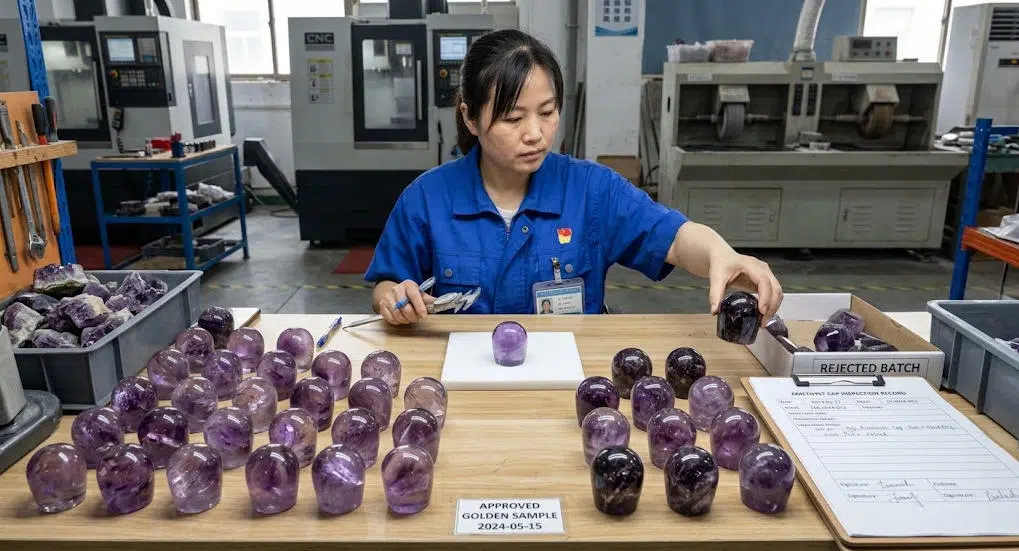
A golden sample was never meant to force every unit into an identical copy of itself. For natural quartz, that expectation is not realistic, and no crystal cap manufacturer working with rough stone can promise it honestly. The more useful definition is this: the golden sample represents the color, transparency, texture, and overall look you have accepted, and production units should sit within an agreed range of natural variation around that object.
What a Golden Sample Standard Actually Covers
A workable range for a crystal perfume cap custom order typically covers four dimensions. Color should stay close to the sample overall, without an obvious shift toward a different hue. Transparency should not fall noticeably below the level the sample represents. Internal texture can vary naturally, but should not include large cracks or unusual mineral inclusions that visibly affect appearance, and overall finish should avoid any defect serious enough to change how the piece reads on a shelf next to your bottle.
Notice what this standard is not attempting to do. It is not trying to erase the natural differences that come from working with real stone instead of resin. It defines which differences fall inside an acceptable window and which fall outside it, so your crystal cap manufacturer and your QC team work from the same yardstick even though the material itself will never be perfectly uniform. The same four-dimension logic applies whether you are approving a crystal lid custom piece in amethyst or a clear quartz cap headed for a minimalist bottle design.
How Requirement Creep Happens After Sample Approval
A separate but related risk sits inside almost every custom order: you approve a sample, production begins, and partway through the run your own eye starts asking for small adjustments. “Could this be a touch lighter?” “Could transparency come up slightly?” Each request feels minor on its own, but by the end of the run the finished caps may have drifted from what you first approved — while your supplier genuinely believes they followed your original instructions the whole time.
This is rarely a case of bad faith on either side. It is what happens when a standard exists only in memory and conversation instead of as a fixed, dated object both sides signed off on before mass production began on a crystal perfume cap custom run. An early approval, a string of small follow-up requests, and a final comparison where the shipped goods barely resemble the very first sample anyone saw — each step along that path felt reasonable in the moment it was made.
Distinguishing Production Drift From Client Revision
A locked and dated Approved Golden Sample interrupts that pattern before it starts, and it changes something practical: who is responsible for the cost of correction. If a shipment strays from an approved golden sample, that is a production issue, and the manufacturer carries responsibility for fixing it. If you request a change to the golden sample itself mid-run, that is a revision, and it typically comes with new cost, new lead time, or both.
For your budget and your schedule, a dated approval record turns a subjective argument about fault into a straightforward comparison, which protects your timeline just as much as it protects your supplier’s margin on the job. That clarity tends to resolve disputes in days rather than weeks, simply because there is nothing left to debate once both sides are looking at the same object.
Risk Disclosure and Compliance: How a Golden Sample Protects Both Sides of a Crystal Perfume Cap Custom Deal

Every crystal perfume cap custom relationship carries risk in both directions, and a golden sample exists to manage that risk for both parties, not to give one side legal cover over the other. Understanding both sides of that risk honestly, before you commit to a large order, is worth the ten minutes it takes.
Risks You Face Without a Documented Standard
Without an approved reference object, you are exposed to a factory quietly lowering visual standards over a long run, batch colors drifting darker shipment after shipment, transparency declining below what you originally saw, and natural texture appearing heavier than expected — with no fixed point to prove any of it against. Each of these risks is hard to argue convincingly without a physical comparison in hand, because “it doesn’t look the same to me” carries far less weight than holding two objects side by side under the same light.
Risks a Crystal Cap Manufacturer Faces Without One
The risk runs the other direction too. A crystal cap manufacturer without a locked reference is exposed to buyers who shift their own aesthetic preference mid-run, introduce a new photo as though it had always been the standard, or treat completely normal natural variation as a defect worth rejecting an entire crystal perfume cap custom shipment over, especially once it has already left the factory as part of a full crystal perfume cap wholesale order. Experienced suppliers push for a documented golden sample just as strongly as careful buyers should, because the protection genuinely runs in both directions.
Why GIA and SSEF Grading Frameworks Matter for Crystal Perfume Cap Custom Buyers
What a golden sample actually settles is a communication and accountability problem, not a taste problem — “is this beautiful” is subjective and will always be debated, while “does this match the object both sides already approved” is close to objective. Independent institutions such as the Gemological Institute of America and the Swiss Gemmological Institute (SSEF) have spent decades building exactly this kind of reference-based grading, specifically because verbal description proves unreliable at scale across a global trade. The International Gem Society’s summary of GIA’s clarity type system classifies quartz varieties such as amethyst and citrine as “Type II” stones, meaning visible inclusions are expected and normal rather than evidence of a lower grade.
Referencing that framework inside a crystal perfume cap custom order gives both sides a shared, external vocabulary instead of relying on each party’s private definition of “clean.” This means fewer disputes escalate into costly rework or delayed shipping over what was, at its core, a preventable misunderstanding rather than an actual quality failure.
Building a Complete Quality System for Crystal Perfume Cap Custom Orders
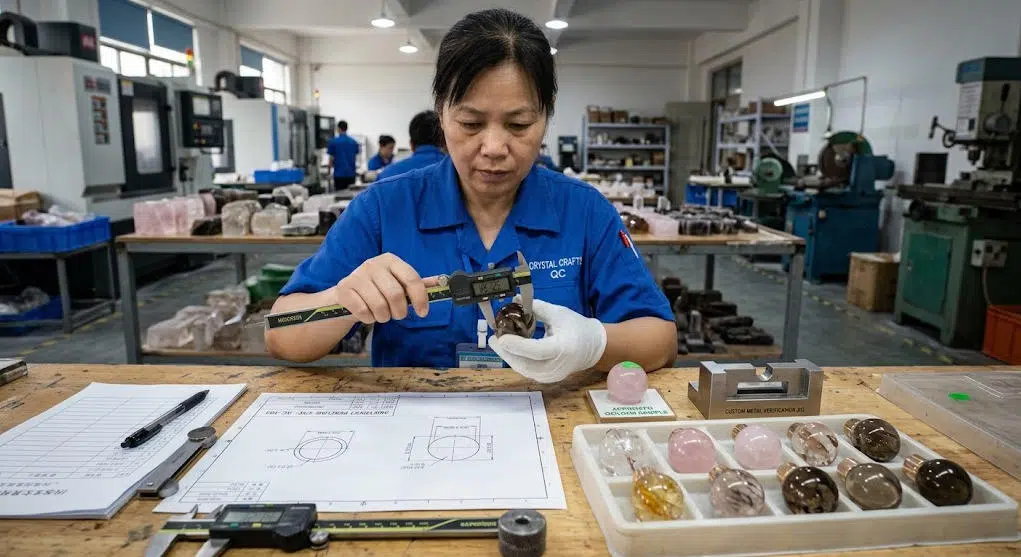
The most reliable crystal perfume cap custom programs never rely on a golden sample alone, and they never rely on a 2D drawing alone either. They combine both, assigning each specification to whichever tool actually controls it — numbers where numbers work, and a physical reference where they do not.
Six Steps to Verify Every Crystal Perfume Cap Custom Order
The workflow itself is straightforward, even though each stage carries real weight. It begins with your requirement, moves into a technical specification with measurable tolerances, proceeds to a golden sample covering everything a drawing cannot capture, continues through production against both references at once, passes through a QC comparison that checks dimensions against the drawing and appearance against the sample, and finishes with a final approval that closes the loop before shipment. Skipping any single stage in that sequence reopens exactly the ambiguity a golden sample was built to remove.
The sequence matters as much as the individual steps here. A golden sample created after production has already started delivers far less value than one locked in before the first cut is made, because it can no longer prevent the very drift it exists to catch on a crystal perfume cap custom run. This workflow holds whether you are running a small trial batch or a full crystal perfume cap wholesale production cycle. Dimensional attributes — outer diameter, bore diameter, height, weight, and insert fit — belong on a drawing with a stated tolerance, since a caliper resolves any disagreement in seconds. Color, transparency, internal natural texture, polish quality, and overall appearance belong with the golden sample instead, because no drawing has ever successfully described what “close enough” looks like in a natural material.
Cost and ROI: What Skipping a Golden Sample Costs a Crystal Perfume Cap Wholesale Buyer
Buyers sometimes treat a golden sample as an added cost and an added delay early in the timeline, and looked at that way, it is easy to see why some try to skip it. Looked at from the cost of what happens when a crystal perfume cap wholesale order goes wrong at scale, the calculation flips completely. A rejected batch after full production rarely means a small correction — it typically means re-cutting or re-sourcing rough material, rebooking production time on a line that has already moved to the next job, and absorbing a shipping delay measured in weeks rather than days.
A golden sample approval, by comparison, is a small fixed cost paid once, before mass production commits real material and real machine time. Think of it as risk-weighted math rather than pure cost comparison: if a properly documented golden sample meaningfully lowers your chance of a large rejected batch, the sample cost functions closer to insurance than to overhead, protecting you against a much larger and far less predictable expense. For a repeat crystal perfume cap custom buyer placing several orders a year, that protection compounds across every run, not only the first one.
The Production Journey to a Finished Crystal Lid Custom Piece
If you have sourced resin caps before, you may wonder why quartz and gemstone caps demand this much more structure around approval. The honest answer is that resin and natural stone follow fundamentally different production processes, not just different materials wearing different price tags. A resin cap moves from a mold, through a color batch, and into a mostly automated finishing line, which is exactly why resin achieves tight, repeatable uniformity across huge volumes.
A crystal lid custom piece follows a completely different path instead: rough stone selection, cutting, shaping, CNC or drilling work for the insert, fine grinding, polishing, cleaning, and manual QC at multiple stages along the way. Nearly every one of those stages touches material that already carries built-in, unremovable variation from the rough stone it started as, which is exactly why a golden sample matters more here than almost anywhere else in the fragrance packaging supply chain. A cutter who has spent years reading rough amethyst and rose quartz can often predict, before a single tray is finished, which sections of stone will sit comfortably inside your approved range and which will not, catching a mismatch before it reaches QC rather than after your container has already left port. This means fewer surprises for you and fewer rejected batches for your supplier, a better outcome for both sides of any crystal perfume cap wholesale relationship.
Final Thoughts: Making Crystal Perfume Cap Custom Orders Predictable
A rendering tells a factory what you want. A golden sample tells a factory what “correct” actually means once real material enters the process, and that difference is the single biggest predictor of whether a crystal perfume cap custom order ships looking like what you approved. If you are planning a run of natural quartz, amethyst, or rose quartz caps, treat the golden sample stage as part of your production timeline, not as an optional add-on you can skip to save a week.
Stone Elf’s production floor builds both a technical specification and a golden sample into every custom order before mass production begins, because that combination is what actually controls outcome on a material this variable. Whether you are finalizing your first crystal lid custom drawing, placing a full crystal perfume cap wholesale order, or scaling an existing line, the rule holds steady either way: define what “correct” looks like in a physical object before you commit machine time to producing five hundred of them.
FAQs About Crystal Perfume Cap Custom Gold Sample
1. What is a golden sample in a crystal perfume cap custom order?
A physical, signed-off cap that defines the exact color, transparency, and texture your factory must match during mass production, replacing vague descriptions with one measurable reference point everyone can check against.
2. Does a golden sample mean every cap must look identical?
No. Natural quartz always carries some variation. The sample sets an acceptable range around itself, so units can differ slightly while still falling within the standard you already approved before production began.
3. Why can’t dimensional tolerance alone guarantee visual consistency?
Calipers confirm size, not appearance. A batch can pass every diameter and height check yet still show noticeable color or clarity differences, since natural stone varies in ways a 2D drawing was never built to capture.
4. Does skipping a golden sample really cost more later?
Often yes. A rejected batch after full production usually means re-sourcing material, rebooking machine time, and weeks of delay, while a golden sample is a small fixed cost paid once before mass production commits real material.
5. How do gemological standards like GIA support this process?
GIA classifies quartz varieties such as amethyst as naturally “included,” giving buyers and factories a shared, independent vocabulary for what counts as normal texture instead of relying on each side’s private opinion.