
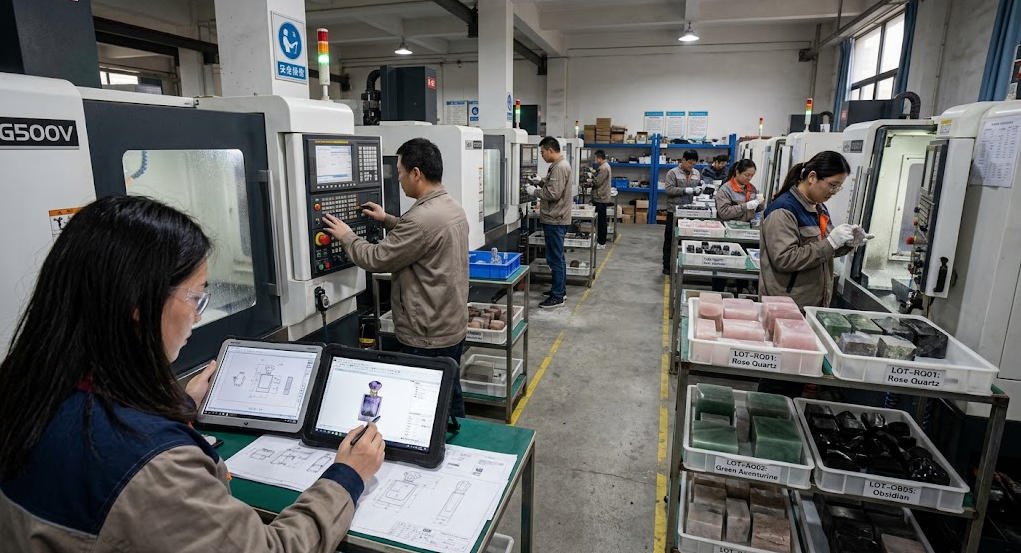
For a crystal lid manufacturer producing natural crystal and stone perfume caps, the lead time gap between a 500-piece order and a 5,000-piece order is usually far smaller than buyers expect. As an illustrative example based on common production sequencing, a 500-piece crystal perfume cap order might run around 25 days from design confirmation to final packaging, while a 5,000-piece order of the same design might run around 35 days — not 250 days, and nowhere close to a proportional tenfold increase. The reason is structural: most early production steps, including drawing confirmation, DFM review, CNC programming and fixture setup, run on a fixed cycle that barely changes with order quantity, while only batch machining and QC actually stretch out as volume grows.
The practical question buyers are really asking when they compare quotes from a crystal perfume cap manufacturer or stone cap manufacturer is whether a bigger order means a proportionally longer wait. It usually does not. A supplier who calculates lead time as unit processing time multiplied by quantity is either inexperienced with batch scheduling or padding the number. The bigger risk buyers should actually be watching for isn’t total days — it’s whether the factory can keep raw material consistency stable once a 5,000-piece order pulls from several rough stone batches instead of one.
Table of Contents
How Lead Time Is Actually Structured: Fixed Preparation vs. Batch Production
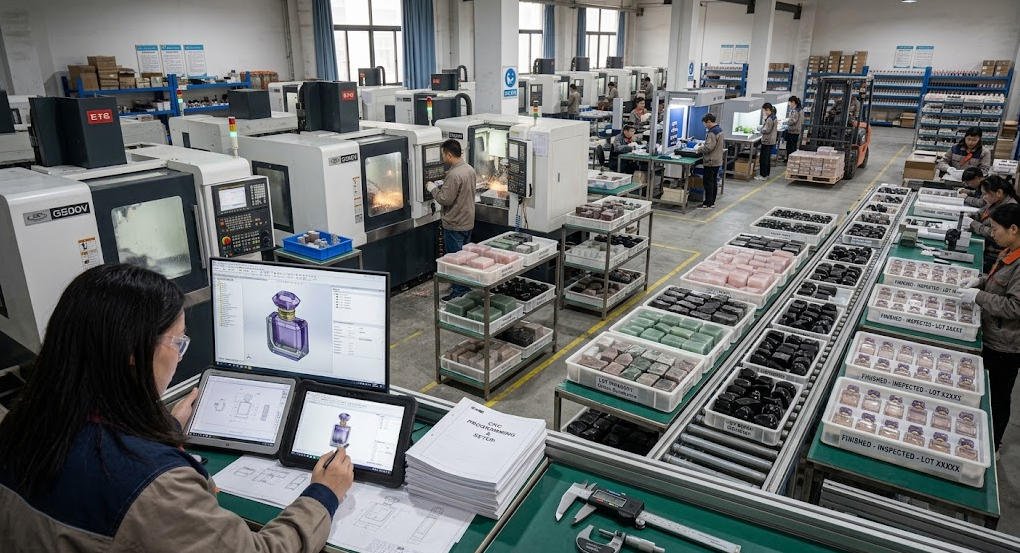
Total lead time for a crystal or stone perfume cap order is not one continuous block of work. It splits into three phases with different scaling behavior: fixed preparation, batch production, and QC/packaging. Fixed preparation covers everything that happens once regardless of whether the order is 500 pieces or 5,000 — 3D drawing sign-off, Design for Manufacturing (DFM) review, CNC program writing, tooling and fixture setup, first-article confirmation, and packaging plan approval. None of these steps get faster or slower based on unit count; a CNC program is written once and reused across the entire run.
Batch production is the phase that actually responds to quantity, because it is where raw material moves through opening, rough shaping, CNC contouring, center drilling, grinding, and polishing in physical volume. QC and packaging sit at the end and scale more mildly, since inspection and packing throughput is closer to linear but still benefits from batching efficiencies. The table below is an illustrative breakdown, not a fixed industry standard, meant only to show where the added time actually lands.
| Phase | 500 pcs (illustrative) | 5,000 pcs (illustrative) |
|---|---|---|
| Fixed preparation | ~10 days | ~10 days |
| Batch production | ~10 days | ~20 days |
| QC / packaging | ~5 days | ~5 days |
| Total | ~25 days | ~35 days |
The formula that follows from this is worth stating plainly: total lead time equals fixed preparation time plus batch production time plus QC/packaging time. It is not unit production time multiplied by quantity. A buyer who understands this distinction can ask a perfume cap factory a much sharper question during quoting — not “how long for X pieces,” but “how much of that time is fixed, and how much actually scales with my quantity.”
Why Design and Engineering Steps Don’t Scale With Volume
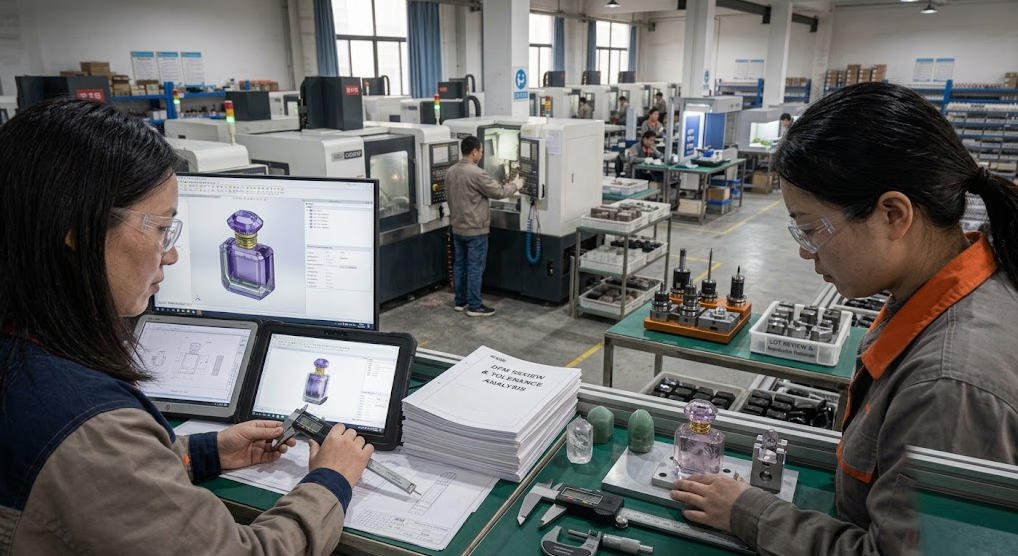
Design Confirmation and DFM Review
Design confirmation and DFM review are conversations between the buyer’s design intent and what the material and tooling can actually deliver, and that conversation takes roughly the same number of rounds whether the final order is 500 pieces or 5,000. During DFM, a manufacturing engineer checks wall thickness at the thinnest point, drilling depth relative to stone diameter, undercuts that CNC tooling cannot reach, and tolerance stacking around the neck-fit area where the cap meets the bottle. In production, a recurring observation is that thin-wall zones near decorative facets are the first place DFM flags for revision, because thin sections in natural stone carry more risk of chipping during grinding regardless of order size.
This phase typically takes a similar number of days at 500 pieces or 5,000 pieces because the reviewers are working from one drawing, not one drawing per unit. So what does this mean for a buyer comparing two quotes? If one crystal perfume cap manufacturer quotes a dramatically shorter design-confirmation window for a small order than a large one, it may indicate the design review is being rushed rather than genuinely shortened by lower volume — and a rushed DFM pass is where downstream tolerance problems usually originate.
CNC Programming, Tooling, and First-Article Confirmation
CNC programming, fixture preparation, and first-article confirmation follow the same fixed-cost logic. A program is written for a part geometry, not for a batch size, and a fixture is built once and reused for every piece that follows. First-article confirmation — producing a small number of sample pieces and checking them against the approved drawing before committing to the full run — happens once per design, not once per thousand units.
This is also where a subtle scheduling reality surfaces: if a factory is asked to compress this stage to save time, the corner most often cut is sample verification depth, not machine setup itself, since the physical setup work cannot really be shortened. A recurring production issue tied to skipping thorough first-article checks is that a geometry deviation only gets caught after a meaningful portion of the batch has already been machined, which costs more time to correct than the days saved at the front end.
What Actually Adds Time: Parallel Batch Processing
Once fixed preparation is complete, the assumption that “500 pieces take 10 days, so 5,000 pieces take 100 days” breaks down because factories with multiple CNC stations, drilling stations and polishing benches run batches in parallel rather than serially. A 500-piece order might reasonably be assigned one or two CNC machines and a small polishing team; a 5,000-piece order of the same design can be split across more machines and more polishing hands running at the same time. Quantity increasing tenfold does not mean production time increasing tenfold, because the constraint is total available capacity across a shift, not the speed of a single machine.
This is why the earlier formula — fixed preparation plus batch production plus QC/packaging — is a more accurate planning tool than a simple per-unit multiplier. It also explains why the batch production phase for 5,000 pieces in the illustrative table above is roughly double the 500-piece figure rather than ten times longer: doubling the machines and hands roughly halves the effective time penalty of the extra volume, even though total material volume is far higher.
Material Behavior: Why Natural Crystal Can’t Be Rushed

Natural crystal and stone are not standardized industrial inputs the way resin or plastic pellets are, and this single fact explains most of why a 5,000-piece order still takes meaningfully longer than a 500-piece one even with parallel machines available. Rock crystal (a form of quartz) sits at roughly 7 on the Mohs hardness scale, the relative ten-point scratch-resistance scale developed by Friedrich Mohs and still used across mineralogy and industry today to compare how minerals behave against one another (Mineralogical Society of America). A hardness of 7 makes the material durable against everyday scratching once finished, but hardness is not the same property as toughness — it does not describe resistance to chipping or fracturing under localized stress, which is the property that actually governs machining risk (geology.com).
Center Drilling and Edge Risk
Center drilling is the step where this distinction matters most. In production, thinner edges and sections closer to the drilled center become more sensitive during machining because less surrounding material remains to absorb stress, which raises the risk of uneven geometry or edge chipping if drilling speed and feed rate are not controlled consistently for that specific stone lot. Internal features invisible from the outside — fine inclusions, growth-plane boundaries, or micro-fractures inherited from the rough stone — can cause a drill bit to exit unevenly even when the exact same program ran cleanly on the previous batch. This is a first-hand observation from batch drilling work, not a claim that any particular defect rate applies universally; actual outcomes depend on the specific stone lot, drill geometry and machine condition.
The practical implication is that a factory cannot simply raise spindle speed to shorten the drilling stage without accepting a higher chance of chipped edges, cracked bores, or scrapped pieces. This is precisely why manufacturers add machines and labor to increase throughput rather than push a single machine faster — a distinction that separates a stone cap manufacturer with batch-scheduling discipline from one that is simply trying to hit a date regardless of scrap consequences.
Batch-to-Batch Material Variation
A 500-piece order can often be completed from a single, relatively consistent lot of rough material. A 5,000-piece order of the same design frequently cannot, because sourcing that much rough crystal in a matching color and clarity range usually requires pulling from multiple raw material lots. Each additional lot introduces its own variation in color tone, clarity, and internal stress pattern, which adds real time to material sorting, opening, color-matching, and QC — not because the process is slower, but because there is more raw material diversity to reconcile against one drawing and one color-consistency standard. This is one of the clearest reasons the batch-production phase for a large order lands closer to double the small-order figure than to a flat, quantity-proportional multiple.
Yield and Unit Efficiency: Why Bigger Orders Can Run Cleaner
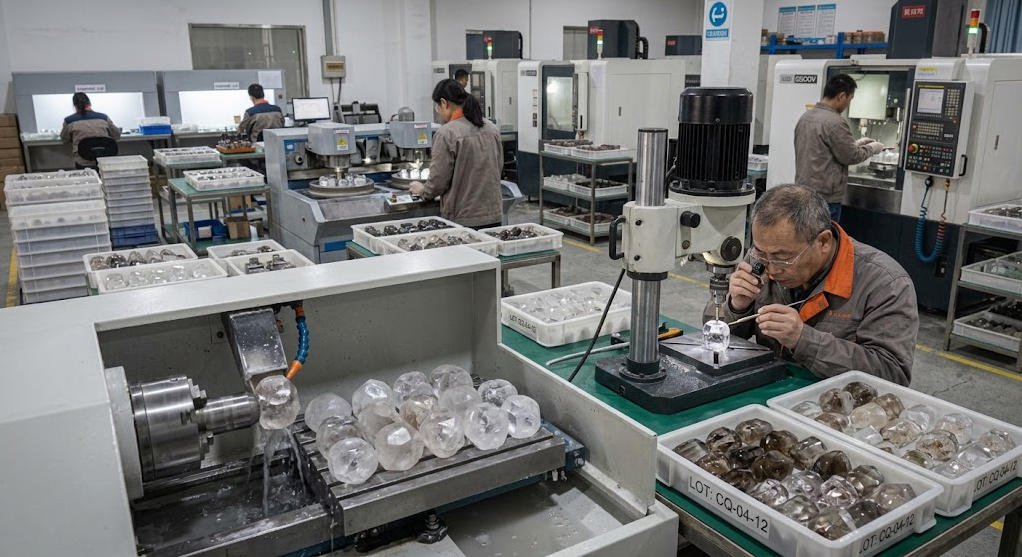
A 500-piece order occupies an awkward position in a factory’s schedule. The factory still performs the full setup sequence — machine calibration, fixture installation, CNC parameter tuning, first-article sign-off, polishing-standard calibration, QC baseline establishment — but that setup cost is amortized over only 500 units. A 5,000-piece order absorbs the same fixed setup cost across ten times the output, and the production line runs continuously rather than being set up, run briefly, and torn down for the next job.
In practice this means: 500 pieces often follows a pattern of setup → produce → changeover → next order, while 5,000 pieces follows setup → continuous production for an extended run. So what does this mean for a buyer estimating cost and time per unit? Per-unit efficiency is not a fixed number that simply scales down from a large-order example — it depends heavily on how much of the fixed setup cost gets divided across the run. A quote for 500 pieces should not be assumed to reflect the same per-unit efficiency as a quote for 5,000 pieces of the identical design, and buyers evaluating perfume cap wholesale pricing across different quantities should expect the setup-cost share, not just the raw material cost, to shift meaningfully between tiers.
The Bottleneck Principle: Pipeline Sequencing Beats Total Volume
Crystal perfume cap production is not a single serial line where every unit must finish CNC before any unit starts drilling. In a pipelined workflow, the first sub-batch moves into drilling as soon as it clears CNC, while the second sub-batch is still being machined; the first sub-batch then moves into polishing while the second enters drilling and a third begins CNC. This cross-stage overlap is what keeps the added time for a larger order concentrated in the length of the batch-production stage, rather than requiring the entire eight-step process to be repeated in full for every increment of volume.
The manufacturing implication is that the real constraint on a large order’s schedule is whichever single stage has the least spare capacity — the bottleneck — not the sum of every stage’s individual duration. If a factory has five CNC machines but only two people trained for fine polishing on faceted crystal, polishing becomes the bottleneck regardless of how much CNC capacity sits idle. A buyer negotiating lead time on a large order gets more useful information by asking which stage is the current bottleneck than by asking for a single blended number.
Illustrative Case Study: Compressing a Drilling Schedule on a Large Crystal Cap Order
The following is an illustrative case study constructed to demonstrate a realistic production risk pattern. It does not describe an actual client, order, or dataset and should not be read as a real production record.
Situation. A brand placed an order for 5,000 pieces of a rounded, center-drilled rock crystal perfume cap and requested that the batch-production window be compressed from an estimated 20 days to 12 days to meet a retail launch date.
Production Condition. The material was natural rock crystal sourced across three rough-material lots to meet the color-consistency requirement at this volume; the design called for a center bore roughly 60% of the cap’s height, a depth-to-diameter ratio that leaves comparatively thin walls near the drill exit point.
Risk. To compress the schedule, drilling spindle speed and feed rate were increased beyond the standard parameter used for the material’s typical hardness and inclusion profile, on the assumption that a faster pass would simply finish sooner without changing outcomes.
Detection. During routine QC sampling partway through the batch, inspectors recorded a higher rate of hairline edge chipping near the drill exit on pieces from one of the three rough-material lots compared to the other two.
Root Cause. The affected lot carried more fine internal inclusions than the other two, a difference not visible without close inspection of the rough stone before cutting; the faster drilling parameter left less margin for that lot’s natural variation, and the combination — not the speed increase alone — produced the elevated chip rate.
Corrective Action. Drilling parameters were reverted to the standard speed and feed used for that hardness range, the affected rough-material lot was re-sorted and the more inclusion-prone pieces were separated out for a design variant with a shallower bore, and an additional light polishing pass was added to the remaining pieces near the drill exit to blend minor surface marks.
Result. The overall batch-production timeline extended by several days relative to the compressed 12-day target, landing close to the original 20-day estimate, and the final scrap rate returned to a normal range rather than the elevated level seen during the faster-parameter run.
Lesson. For a buyer, requesting a compressed batch-production window on a natural stone product is not simply a scheduling request — it is a request to reduce the margin the process has for the material’s own variation. Once rework and re-sorting are counted, a compressed schedule on natural stone frequently ends up costing time rather than saving it, and the practical decision point for buyers is asking a supplier what specifically will change in the process to hit a shorter date, not just whether they will agree to one.
A Practical Decision Framework for Evaluating Crystal Perfume Cap Lead Times

Buyers comparing quotes across a crystal perfume cap manufacturer, a stone cap manufacturer, or a broader perfume cap wholesale supplier get more useful information from a short set of specific questions than from comparing a single total lead-time number:
- Ask the supplier to break the quoted lead time into fixed preparation, batch production, and QC/packaging, rather than accepting one combined figure.
- Ask how many CNC, drilling, and polishing stations will actually be allocated to your order, since this determines whether the batch stage runs in meaningful parallel.
- Ask whether the raw material batch has already been sourced or reserved for your order, or whether sourcing timing is still open — this materially affects both lead time and color-consistency risk.
- Ask what the historical chip or crack rate looks like for a similar design and drill-depth ratio at your target quantity, and what QC sampling method is used to catch it.
- Ask directly whether lead time changes proportionally if quantity moves up or down by a meaningful margin — a supplier who cannot explain why it does not scale linearly may not actually be planning capacity in advance.
These questions matter more for natural stone products than for resin or plastic caps, because the answers reveal whether a perfume cap factory is planning around real capacity and real material behavior, or simply quoting a number to win the order.
Conclusion
The gap between a 500-piece and a 5,000-piece crystal or stone perfume cap order is driven almost entirely by what happens in the batch-production stage, not by a proportional expansion of the entire manufacturing process. Fixed preparation steps — drawing confirmation, DFM, CNC programming, tooling, first-article sign-off — cost roughly the same regardless of volume, while natural material variation, drilling risk, and bottleneck capacity are what stretch a larger order’s timeline by a manageable margin rather than a multiplied one. For a buyer working with any crystal lid manufacturer, the more useful comparison point is not “how many days total,” but which phase of that timeline actually moves when quantity changes — and whether the supplier can explain why.
References
- Mineralogical Society of America. “Mohs’ Scale of Hardness.” http://www.minsocam.org/msa/collectors_corner/article/mohs.htm
- Geology.com. “Mohs Hardness Scale: Testing the Resistance to Being Scratched.” https://geology.com/minerals/mohs-hardness-scale.shtml
- International Organization for Standardization (ISO). “ISO 9001 Explained.” https://www.iso.org/home/insights-news/resources/iso-9001-explained.html
Written by the Manufacturing Content Team — production and quality-control perspective drawn from crystal and stone perfume cap manufacturing, covering CNC machining, center drilling, grinding, polishing, and batch QC.
Manufacturing Disclaimer
This article is written from a manufacturing and production-planning perspective to help buyers understand how crystal and stone perfume cap lead times are structured. The day figures, tables, and the case study in this article are illustrative examples used to explain production logic; they are not fixed industry standards, guaranteed quotes, or records of a specific real order. Actual lead time, yield, and scrap rates depend on the specific stone material, design geometry, order quantity, available equipment, staffing, and the quality-control standards applied at the time of production. References to ISO 9001 describe the general quality management standard published by ISO and do not represent a certification claim by any specific company unless independently verified. Nothing in this article constitutes legal, regulatory, or compliance advice.