
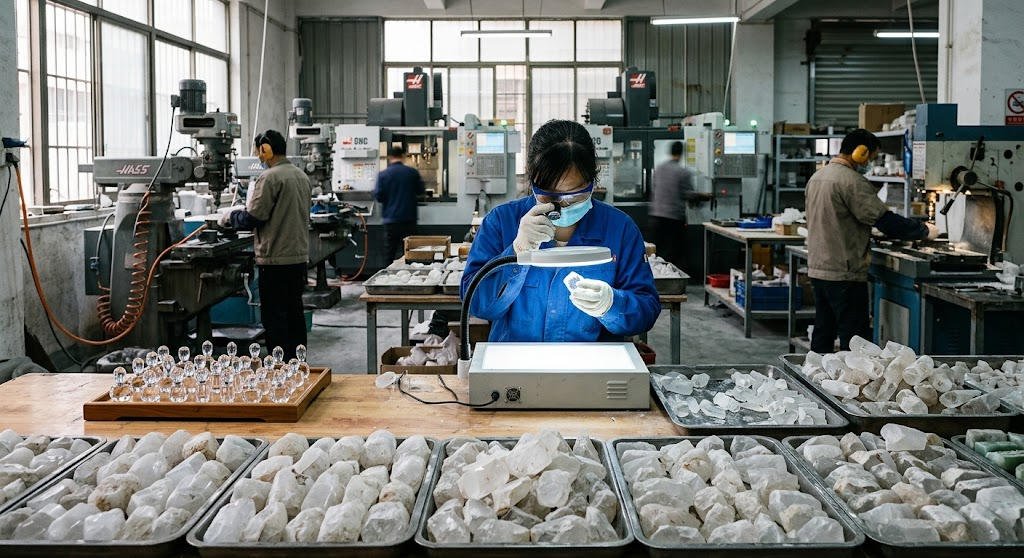
Not every stone that looks good on a mood board survives a crystal perfume cap production line. Out of ten natural materials brands commonly ask about — quartz, amethyst, rose quartz, agate, chalcedony, calcite, fluorite, malachite, lapis lazuli, and turquoise — only five hold up through center-hole drilling, thin-wall CNC shaping, and repeat polishing once order volume passes 1,000 pieces. That split is the first number a working crystal cap manufacturer gives you before quoting a project: roughly half of the “photogenic” stones on a sourcing shortlist cannot be turned into 5,000 matching caps without yield dropping under 70%. If nobody has shown you where that missing 30% actually goes, this breakdown walks through it from the factory floor, not a catalog page.
Table of Contents
What a Crystal Cap Manufacturer Actually Checks Before Approving a Stone
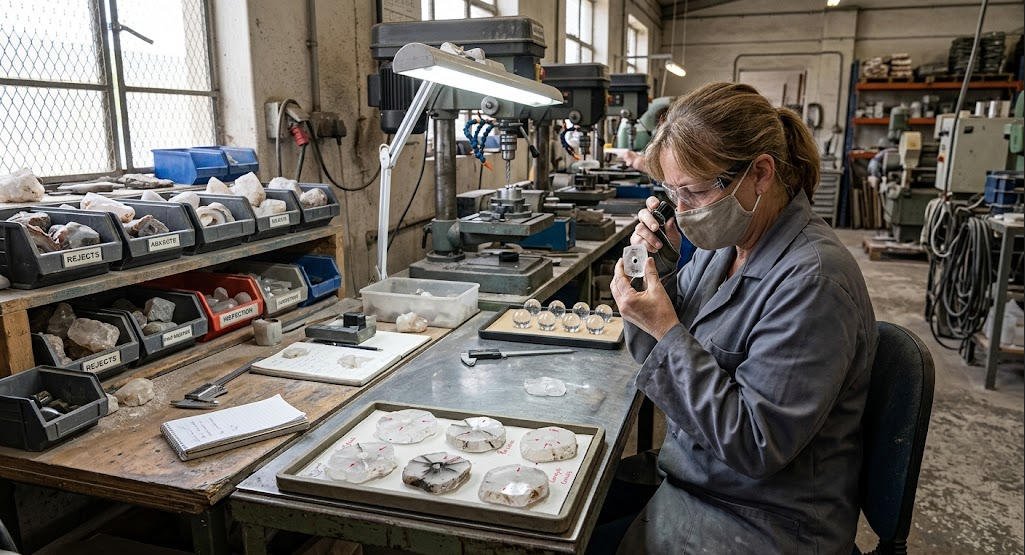
A perfume cap is not a pendant, and it is not a display carving. It goes through rough-cutting, CNC or lathe shaping, center-hole drilling, internal structure work, grinding, polishing, and final assembly onto a bottle neck. Each of those steps stresses the stone in a different direction, so “does it look nice” is only the first of nine questions a stone cap manufacturer actually has to answer before booking a production slot. This means you can walk into a sourcing conversation already knowing which questions separate a workable material from an expensive mistake.
Hardness Alone Won’t Tell You If a Cap Survives Drilling
Hardness gets the most attention because it is the easiest number to quote, but it answers only one question: how well a surface resists scratching. GIA’s own durability research is direct about this — hardness, toughness, and stability are three separate properties, and a stone can rank high on one while failing badly on another. A material with a Mohs score of 7 cuts and polishes on established diamond-tooling lines, while anything under 4 scratches during ordinary handling, packaging, and shipping, long before a customer ever twists the cap. So does a high Mohs number guarantee a clean drill hole? Not on its own — and that gap is exactly where most sourcing mistakes start.
Why a Crystal Cap Manufacturer Worries About Cracks You Can’t See
Toughness and cleavage matter more than hardness once drilling starts. The International Gem Society’s cleavage research explains that cleavage is a structural weakness running through the crystal lattice — a plane where the atomic bonds are already thinner than everywhere else. Drilling introduces rotational force, lateral pressure, vibration, and localized heat all at once, and a cleavage plane sitting anywhere near that bore is where a blank splits. This means your supplier’s crack-screening process, not the raw material cost, is usually what determines whether your center-hole reject rate sits at 5% or 25%.
Internal fractures behave the same way, except they hide inside the rough before cutting even begins. A single hairline crack invisible to the naked eye can travel the moment a diamond bit touches it, and one bad blank in a batch of a hundred rarely stays isolated — it usually signals the whole lot came from a fractured section of the same rough. A crystal lid factory running consistent volume screens for this before rough ever reaches the saw, not after a customer complains about a chipped edge six weeks later.
Porosity and Batch Consistency: The Numbers Behind the Price Tag
Porosity decides something different: what happens after the cap leaves the factory. A porous stone absorbs alcohol, fragrance oil, and adhesive over time, which changes both its appearance and its structural stability near the glued joint. Structural uniformity decides something else again — whether the same CNC parameters that worked on blank #1 still work on blank #400, or whether your operator is re-tuning the machine every hour because the material behaves differently piece to piece. Color consistency and raw material supply round out the list, because a stone that only exists in small, uneven batches cannot support a repeat order, no matter how it photographs. This means you can treat “will 5,000 pieces look and perform the same as the first 50” as the real test, not “does one polished sample look good in a sample box.”
5 Natural Crystals a Crystal Cap Manufacturer Can Put Into Production
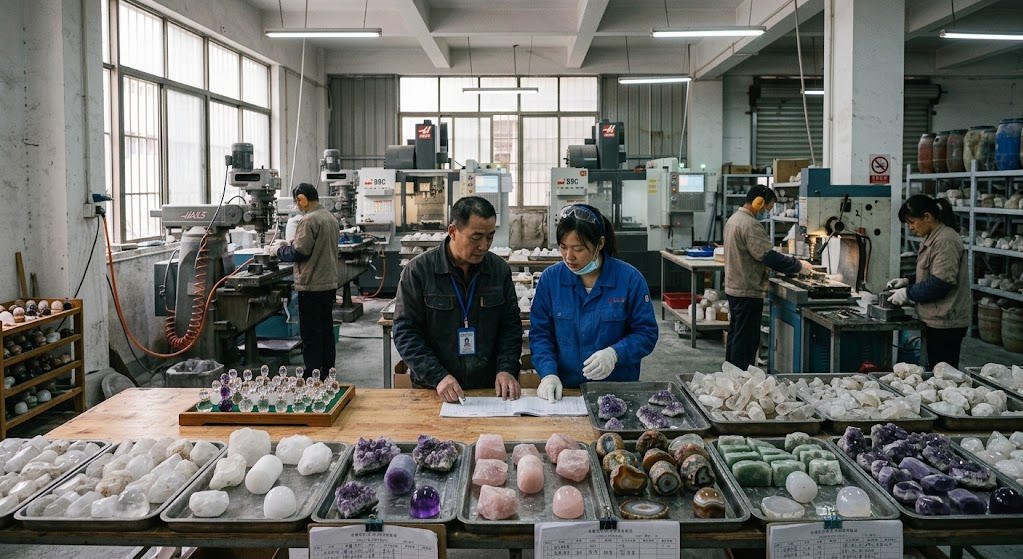
Five materials pass this filter with enough consistency to support standardized orders. They are not the only stones that can technically be cut into a cap shape — they are the ones that cut, drill, and polish predictably enough to plan a production schedule around.
Quartz: The Default Choice for a Crystal Cap Manufacturer Running Volume Orders
White quartz sits at Mohs 7, which is hard enough to resist daily scratching but not so hard that it inflates tooling costs the way harder gem materials do. It cuts on standard diamond-wheel and diamond-bit setups already used across the lapidary trade, so a crystal cap manufacturer is not building a custom process from zero for every order. Fine-grade quartz reaches a glass-like polish and ranges from transparent to semi-transparent, which sits visually close to the perfume bottle itself instead of fighting it. Quartz is also one of the most abundant minerals on earth, so sourcing 500, 2,000, or 10,000 matched blanks is a supply problem your factory can actually solve. This means you can plan a large-format launch around quartz without building in a six-month lead time just to find enough clean rough.
Amethyst: Strong on the CNC Bed, Harder to Match on Color
Amethyst is quartz’s purple variety, so it inherits the same Mohs 7 hardness and the same mature cutting infrastructure. What it does not inherit is color uniformity — GIA’s own gemological notes describe amethyst as prone to visible color zoning, angular bands of darker and lighter purple within a single stone, along with natural variation from pale lilac to deep violet across different rough sources. That is not a manufacturing defect; it is how the crystal grew. A crystal perfume cap production run in amethyst needs rough graded by color band before cutting even starts, or a 2,000-piece order arrives with visibly mismatched caps sitting in the same shipment. This means you can still use amethyst for a premium SKU, as long as your supplier grades rough by shade before cutting rather than after.
Rose Quartz: Why Beauty Brands Keep Reordering It
Rose quartz shares quartz’s Mohs 7 hardness and polishing behavior, and GIA describes its color as ranging from very light pink to a medium-dark pink, with a translucent quality that comes from microscopic mineral inclusions rather than a flaw in the cut. That soft haze reads as a feature in beauty and wellness packaging rather than a defect, which is part of why skincare and fragrance brands keep specifying it by name. Supply is broad enough to support repeat commercial orders, and the material’s main quality variable — internal cloudiness, or “cotton” — is something a grading step can sort for before cutting rather than something you discover after polish. This means a rose quartz order can scale from a 500-piece capsule collection to a multi-thousand-piece standing SKU without changing suppliers.
Agate: Banding That Turns a Production Flaw Into a Selling Point
Agate is a cryptocrystalline quartz variety, meaning it is built from tightly packed microscopic crystals rather than one large clear crystal, and that density is exactly what makes it cut, drill, and polish predictably at Mohs 6.5–7. Its natural banding — layered rings of color and translucency built up during formation — means no two caps are ever perfectly identical, which most brands treat as the point rather than the problem. The tradeoff is that band placement, color, and transparency vary rough to rough, so a stone cap manufacturer needs a sorting step to keep an order looking like one cohesive product line instead of ten different ones. This means agate works best for collections that want visible natural variation as a design feature, not for a SKU that needs to look identical bottle to bottle.
Chalcedony: The Material That Behaves Like an Engineering Part
Chalcedony belongs to the same quartz-chalcedony family as agate, but finer-grained material runs denser and more structurally even, which matters more than almost any other property once a design calls for thin walls or tight internal geometry. The International Gem Society classifies chalcedony’s tenacity as “tough,” a rating that reflects real resistance to chipping and cracking rather than raw scratch hardness. Quality does vary meaningfully by mine source, so not every parcel of chalcedony performs the same on a CNC bed — sourcing from a consistent origin matters more here than with quartz or rose quartz. This means chalcedony is the material to specify when your cap design includes a narrow neck, a slim wall, or any geometry with little margin for error.
5 Stones a Crystal Cap Manufacturer Flags Before the Order Ships
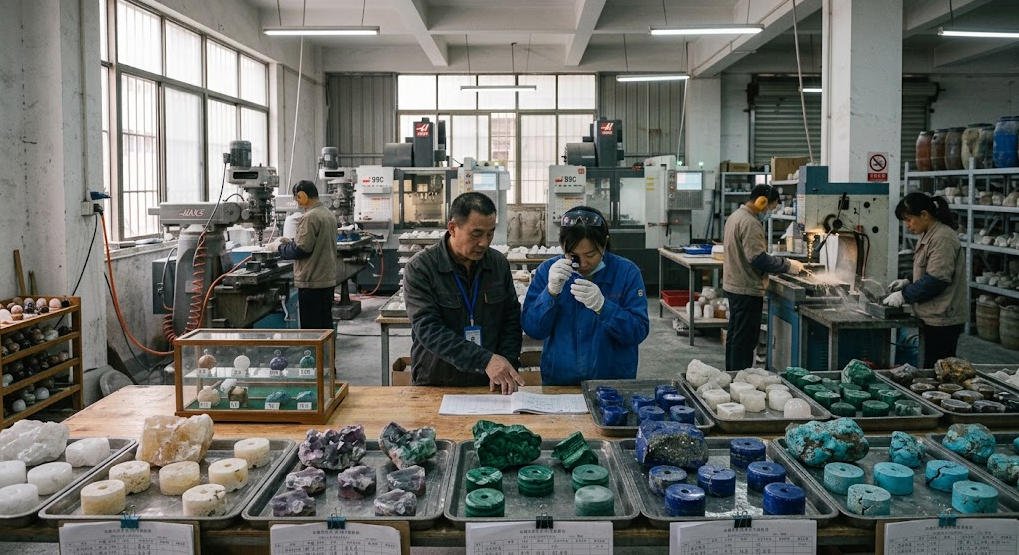
These five materials are not disqualified from lapidary work in general — carvers and jewelers use all of them. The problem is narrower: none of them holds up reliably across a standardized run of thousands of matching perfume caps, and each one fails for a different structural reason.
Calcite: Soft Enough to Scar During Its Own Packaging
Calcite sits at roughly Mohs 3, which puts it well below the household dust and grit that a cap encounters during ordinary handling, packing, shipping, and retail display. The issue is not whether calcite can be cut — it cuts easily, which is part of the appeal — it’s whether the finished edge still looks new after transit and a few months on a vanity. Corners, grooves, drilled openings, and thin walls are exactly the features that chip first on a soft, brittle stone, and a crystal cap manufacturer sees this show up as returns, not as a cutting-floor problem. This means calcite can still work for a display piece or a one-off gift item, but it is a poor match for anything sold as a durable, everyday accessory.
Fluorite: When Cleavage Overrules the Hardness Number
Fluorite scores around Mohs 4, but the number that actually matters here is its cleavage, which the International Gem Society describes as one of the most pronounced in the mineral world — a plane of atomic weakness running straight through the crystal where it will split cleanly under the right kind of force. Center-hole drilling generates rotational torque, lateral pressure, and localized heat all at once, and any of those can trigger a break along that plane mid-drill. So why does fluorite still tempt buyers? Because raw fluorite looks striking under gallery lighting, and that visual appeal has nothing to do with whether it survives a drill press. This means an order built around fluorite needs a fundamentally different, slower process than a quartz-family order — and that difference shows up directly in cost and lead time.
Malachite: Beautiful Banding, Unpredictable Cutting Response
Malachite runs Mohs 3.5–4 and carries the same banded, layered structure that makes it so recognizable — but that banding is also the problem. Different bands within the same piece can respond differently to a cutting tool, which complicates process control specifically around thin walls and drilled edges, where a crystal lid factory has the least room for variation. Large, evenly patterned rough suitable for premium products is also limited in supply, which naturally caps malachite at small, curated runs rather than standardized volume orders. This means malachite fits a limited-edition capsule collection well, but it is not the material to specify for a repeat SKU running into the thousands.
Lapis Lazuli: A Rock, Not a Single Mineral
Here is the detail most sourcing conversations skip: lapis lazuli is not one mineral, it is a rock — an aggregate mostly made of lazurite, calcite, and pyrite, each with different hardness and different brittleness. A cutting tool moving across a single blank can pass through three different materials in one pass, and each reacts differently, which raises the odds of localized chipping and uneven polish. Independent labs such as SSEF, the Swiss Gemmological Institute, exist precisely because aggregate stones like this need expert verification of composition and quality before a buyer commits to volume. Higher-grade lapis also carries a higher raw material cost, which pushes it further toward small, high-value runs and further away from standardized mass production. This means lapis lazuli belongs in your product line as a limited, premium piece — not as the material behind a 5,000-unit core SKU.
Turquoise: Why Porosity Rules It Out of Standard Runs
Turquoise runs Mohs 5–6, softer than quartz but not dramatically so — the real disqualifier is porosity. Turquoise forms as a cemented aggregate rather than a single crystal, which the International Gem Society and GIA both describe as producing a naturally porous structure, and that same porosity is why most turquoise on the market today is stabilized with resin before it ever reaches a cutter. A perfume cap sits in constant proximity to alcohol, fragrance oil, and adhesive, and an untreated porous stone absorbs all three over time, changing color and weakening the material right at the glued joint. High-grade, low-porosity turquoise exists, but not in the volume or price band that supports large batch orders. This means turquoise works for a small-batch, high-price product line, but it is not the material to build a standard, repeatable catalog item around.
Inside the Factory: How a Crystal Cap Manufacturer Handles the Center-Hole Problem

A natural stone cap is not just a shape ground down from a block — it almost always needs a precise center bore running through material that has to stay structurally thin around it. That sequence typically runs through exterior shaping, center positioning, drilling, hole refinement, exterior grinding, polishing, and final internal assembly, and every one of those steps depends on the step before it going right.
Drilling is where most of that risk concentrates. A bit under rotation generates torque, lateral pressure, friction heat, and vibration simultaneously, and any hidden crack, cleavage plane, or inclusion sitting near the bore path can turn a five-minute operation into a scrapped blank. This is exactly why toughness and internal-crack screening carry as much weight in material selection as raw Mohs hardness — a stone can be hard enough to resist scratching and still fail the moment a bit reaches its center. So what does that mean in practice? It means the drilling stage is where a crystal cap manufacturer either protects your yield or quietly erodes it, and it is worth asking any supplier exactly how they screen rough before it reaches this step, not after.
Wall thickness compounds the risk further. A cap with a slim profile has less material buffering the bore from the outer edge, so the margin for error at the drilling stage shrinks as the design gets more refined. This means a bold, minimalist cap design is not just a styling choice — it is a manufacturing decision that determines how tightly your supplier needs to control every step before drilling even begins.
The Yield Math Behind a 5,000-Piece Crystal Perfume Cap Production Run

Here’s the number that catches most first-time buyers off guard: ordering 5,000 finished caps does not mean sourcing 5,000 pieces of rough. Natural stone has to move through rough screening, cutting, crack elimination, color grading, drilling, polishing, and final QC before it counts as a shippable unit, and loss happens at almost every one of those stages. If your final yield lands at 70% — a realistic number for a well-controlled quartz-family run — you need north of 7,000 qualified blanks to deliver 5,000 finished caps, and that’s before accounting for size sorting or color-matching losses on top.
This is why yield rate, not raw material price per kilogram, usually decides your real cost per finished cap. A material priced cheaply per kilo but yielding only 40% can end up more expensive per finished unit than a pricier material yielding 75%, because you’re paying for the rough that gets rejected along the way, not just the rough that survives. So when a quote looks unusually low, the question worth asking isn’t “is this a good price” — it’s “what yield rate is this price actually built on?” A crystal cap manufacturer that can’t answer that question in specific percentages usually hasn’t run the material at volume yet.
Why Rare and Beautiful Isn’t the Same as Scalable
A stone can be stunning and still be the wrong choice for a standing SKU. Ten hand-selected pieces of rare, uneven rough might make a striking limited-edition capsule, but that same rough, sourced at 10,000-piece scale, runs into batch-to-batch color drift, inconsistent supply, and unpredictable processing loss — the exact problems a repeat order can’t absorb. This means the right question isn’t “can this material be cut into a cap,” since almost anything can be cut into something. The right question is whether it can be cut into the same cap, at an acceptable cost, five thousand times in a row without your QC pile growing faster than your finished-goods pile.
Material Comparison at a Glance

Putting hardness, structural stability, drilling behavior, polish, supply, and batch consistency side by side makes the pattern easier to see at once. Every rating below reflects how the material performs specifically in cap production — center-hole drilling, thin-wall shaping, and repeat polishing — not how it performs as a loose gemstone or jewelry stone, where the priorities are different.
| Material | Hardness | Structural Stability | Drilling | Polish | Supply | Batch Consistency |
|---|---|---|---|---|---|---|
| Quartz | ★★★★★ | ★★★★☆ | ★★★★☆ | ★★★★★ | ★★★★★ | ★★★★☆ |
| Amethyst | ★★★★★ | ★★★★☆ | ★★★★☆ | ★★★★★ | ★★★★☆ | ★★★☆☆ |
| Rose Quartz | ★★★★★ | ★★★★☆ | ★★★★☆ | ★★★★★ | ★★★★☆ | ★★★★☆ |
| Agate | ★★★★☆ | ★★★★☆ | ★★★★☆ | ★★★★★ | ★★★★★ | ★★★★☆ |
| Chalcedony | ★★★★☆ | ★★★★☆ | ★★★★☆ | ★★★★★ | ★★★★☆ | ★★★★☆ |
| Calcite | ★★☆☆☆ | ★★☆☆☆ | ★★☆☆☆ | ★★★☆☆ | ★★★★☆ | ★★★☆☆ |
| Fluorite | ★★☆☆☆ | ★☆☆☆☆ | ★☆☆☆☆ | ★★★☆☆ | ★★★☆☆ | ★★☆☆☆ |
| Malachite | ★★☆☆☆ | ★★☆☆☆ | ★★☆☆☆ | ★★★☆☆ | ★★★☆☆ | ★★☆☆☆ |
| Lapis Lazuli | ★★★☆☆ | ★★☆☆☆ | ★★☆☆☆ | ★★★☆☆ | ★★★☆☆ | ★★☆☆☆ |
| Turquoise | ★★★☆☆ | ★★☆☆☆ | ★★☆☆☆ | ★★★☆☆ | ★★☆☆☆ | ★★☆☆☆ |
Read this table as a starting filter, not a final verdict. A stone cap manufacturer still needs to test your specific cap geometry against your specific rough source, because wall thickness, hole diameter, and design complexity all shift how forgiving a material needs to be. This means the table tells you where to start looking — your actual production trial tells you where to land.
How to Evaluate a Stone Before Your Crystal Cap Manufacturer Starts Tooling

You don’t need a gemology degree to ask the right questions before committing to a material — you need a sequence. Here’s the order that actually protects your order:
- Ask for the Mohs hardness and the tenacity rating separately. A supplier who only quotes hardness is giving you half the picture; tenacity (brittle, tough, or fragile) tells you how the stone behaves under drilling stress, not just under a scratch test.
- Request a small trial batch before a full production run. Twenty to fifty pieces run through your actual cap design will surface drilling and wall-thickness problems that a sample block never will.
- Ask for the real yield percentage from that trial, not an estimate. This is the number that determines your true cost per finished cap.
- Confirm color-grading and sorting procedures if your design depends on visual consistency across the full order.
- Get treatment disclosure in writing — whether the stone is natural, dyed, impregnated, or stabilized, and how that was determined.
This means you walk into a supplier conversation with a checklist instead of a gut feeling, and a crystal lid factory that hesitates on any of these five points is telling you something worth hearing before you place a deposit, not after.
Compliance and Lab Standards a Crystal Cap Manufacturer Should Reference
Natural stone claims need to be verifiable, not just stated. Independent gemological bodies exist specifically to test and document what a stone actually is — GIA maintains detailed reference material on how gemstones are treated, including impregnation and stabilization methods commonly used on porous stones like turquoise, and the International Gem Society publishes a comparable overview of turquoise treatment and identification standards. SSEF, the Swiss Gemmological Institute, has operated as an independent testing authority for coloured stones since 1972, and its role matters most for aggregate or multi-mineral materials like lapis lazuli, where composition can vary piece to piece within the same parcel.
Most markets that regulate jewelry and gemstone sales expect treatments to be disclosed to the buyer — whether a turquoise cap has been resin-stabilized, whether a rose quartz has been dyed, or whether a stone is entirely untreated. This isn’t a formality; it protects you from a compliance problem showing up after your product is already on shelves, not before. Since disclosure requirements vary by market, it’s worth confirming the specific standard your target region expects rather than assuming one set of rules applies everywhere. This means the right supplier conversation isn’t just “is this stone natural” — it’s “can you document that, and to which lab standard.”
About Stone Elf: A Crystal Cap Manufacturer Working From Rough to Finished Cap
Stone Elf has spent over 12 years running natural stone, crystal, and jade perfume cap production from raw material through to finished, assembled product. That means the crack-screening, yield tracking, and drilling-risk assessment described throughout this guide isn’t theoretical — it’s the daily process behind every order that leaves Stone Elf’s floor. If you’re comparing rough quotes right now and want a second opinion on whether a material will actually hold up at your target volume, that’s the kind of question Stone Elf answers before you commit, not after.
You can send your cap design, target volume, and material shortlist directly, and get a realistic yield estimate and production timeline back — grounded in what the material actually does on a drill press, not just how it photographs. That’s the difference between a supplier who quotes a price and a crystal cap manufacturer who quotes a process.
